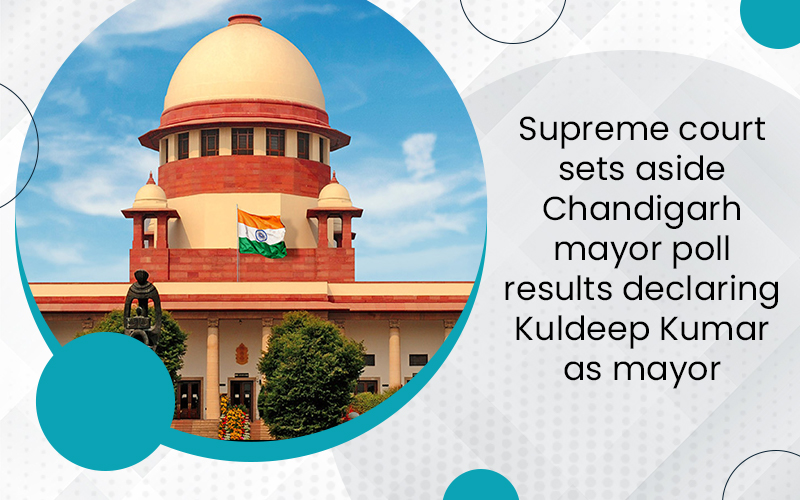
Kuldeep Kumar (Appellant) Vs. UT Chandigarh and ors ( Respondents)
Civil Appeal No 2874 of 2024
(3JB, Dr DY Chandrachud, J B Pardiwala and Manoj Misra JJ., delivered by DY Chandrachud CJ.)
Facts: The present appeal arises from an interim order of a Division Bench of the High Court of Punjab & Haryana dated 31 January 2024. The order impugned originates in a writ petition alleging electoral malpractices by the presiding officer who conducted the election to the post of Mayor at the Chandigarh Municipal Corporation. The High Court issued notice and listed the petition after three weeks, but it declined to stay the result of the election or grant any other interim relief. The appellant approached this Court assailing the Order and raised serious allegations about the sanctity of the election. With the course the proceedings have taken, this judgment will result in a final order on the writ petition before the High Court.
Issue: Whether the election result is liable to be set aside by the court in the present facts of the case?
Arguments on behalf of counsel for appellant:
The appellant submitted that he would be content if the petition was disposed of with directions to the official respondents to (a) acknowledge the acceptance of the withdrawal of the candidature of certain individuals for the three electoral posts; (b) permit persons nominated by the contested candidates to observe the proceedings of the elections; and (c) video record the entire election process.
Arguments on behalf of counsel for respondents:
It was stated on behalf of the respondents representing the various authorities, inter alia, that the entire voting and election process would be video recorded. Likewise, it was stated that the Chandigarh police would ensure that free and fair elections take place. In view of the position adopted by the authorities, by an Order dated 17 January 2024 (a day before the proposed election), the petition was disposed of by a Division Bench of the High Court.
Held: The court disposed off the present petition and held that, “Elections at the local participatory level act as a microcosm of the larger democratic structure in the country. Local governments, such as municipal corporations, engage with issues that affect citizens’ daily lives and act as a primary point of contact with representative democracy. The process of citizens electing councillors, who in turn, elect the mayor, serves as a channel for ordinary citizens to ventilate their grievances through their representatives – both directly and indirectly elected. Ensuring a free and fair electoral process throughout this process, therefore, is imperative to maintain the legitimacy of and trust in representative democracy. We are of the considered view that in such a case, this Court is duty-bound, particularly in the context of its jurisdiction under Article 142 of the Constitution, to do complete justice to ensure that the process of electoral democracy is not allowed to be thwarted by such subterfuges.”