Southern Power Distribution Company of Andhra Pradesh Ltd. and Anr. {Appellant(s) } Vs. Green Infra Wind Solutions and Ors. {Respondent(s)}
Civil Appeal No. 4495 OF 2025
(DB, Pamidighantam Sri Narasimha & Atul S. Chandurkar, JJ.)
Overview
In this matter, the Supreme Court addressed an important question as to the electricity tariffs and government incentives. The case was whether a State Electricity Regulatory Commission(SERC) can reduce the amount to be paid to power generators by adjusting a financial incentive by the Central Government. The dispute arose between the companies in Andhra Pradesh dealing with power distribution and wind energy companies as to Generation Based Incentive(GBI), which was introduced to promote renewable energy production. The Andhra Pradesh Electricity Regulatory Commission(APERC), decided that this incentive should be deducted from the tariff, which is payable to the generating companies.
This decision was challenged before the Appellate Tribunal for Electricity(APTEL), which eventually ruled in favour of the generators. The matter then came before the Supreme Court, whereby it had to decide whether such an incentive can be adjusted while calculating tariff or whether it must remain an additional benefit to the generators.
Facts of the Case
In 2009, the Ministry of New and Renewable Energy introduced the GBI scheme. Under this scheme, the wind energy generators were given ₹0.50 per unit of electricity supplied to the grid. The scheme also mentioned that this incentive would be given above the tariff which is fixed by the regulatory authorities.
Later in 2015, the APERC introduced regulations for determining tariffs for the wind power projects. One of the clauses stated that any incentives provided by the government should be taken into account. Initially, APERC did not consider the same. However, in 2018, after several distribution companies requested, it held that GBI would be deducted from the payments made to the generators so that the consumers can benefit from the reduced costs.
This decision was challenged by the generating companies before APTEL, which set aside APERC’s decision and held that the GBI was not meant to reduce tariffs. Following the same, the distribution companies then approached the Supreme Court.
Legal Issues
- Whether the SERC holds the power to adjust government incentives while fixing tariffs.
- Whether the Generation Based Incentive can be used to reduce the tariff payable to the generating companies.
- Whether the phrase “taken into consideration” implies that such incentives must be deducted while calculating tariffs.
- Whether decisions by regulatory authorities should consider the purpose behind government schemes and incentives.
Decision
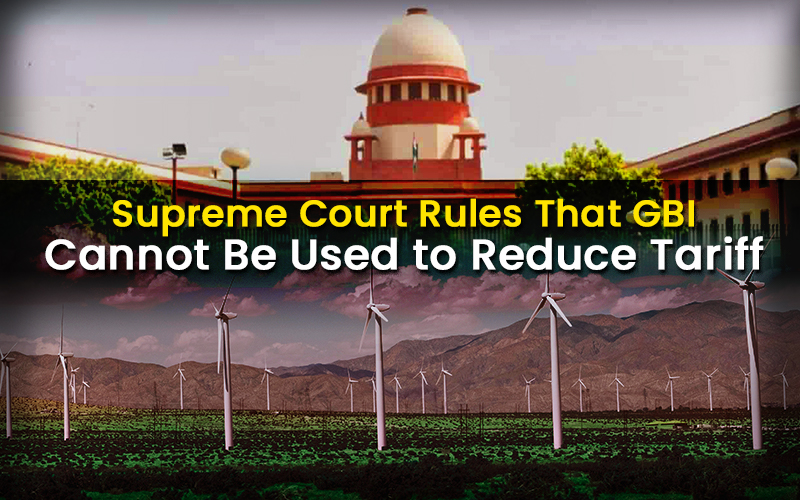
The Supreme Court upheld the decision of APTEL and clarified that even though the regulatory commissions have the authority to fix tariffs, they cannot exercise it in a way that hinders the objective of government policies and schemes. The phrase “taken into consideration” does not mean that the incentive should be deducted. It rather asks for a balanced approach. In the current scenario, the GBI was introduced to promote renewable energy. If it is deducted from the tariff, it neglects the purpose and benefit of the scheme given to the generators.
The court also highlighted that India has certain commitments towards promotion of clean and renewable energy and such incentives play an important role in achieving those goals. Therefore, it was held that GBI should remain an additional benefit given to the generators, and it should not be adjusted while fixing the tariffs.