V.S. PALANIVEL [APPELLANT] Vs. SRIRAM, CS, LIQUIDATOR, ETC. [RESPONDENTS]
CIVIL APPEAL NOS. 9059-9061 OF 2022
(2JB, HIMA KOHLI and AHSANUDDIN AMANULLAH JJ., delivered by HIMA KOHLI, J.)
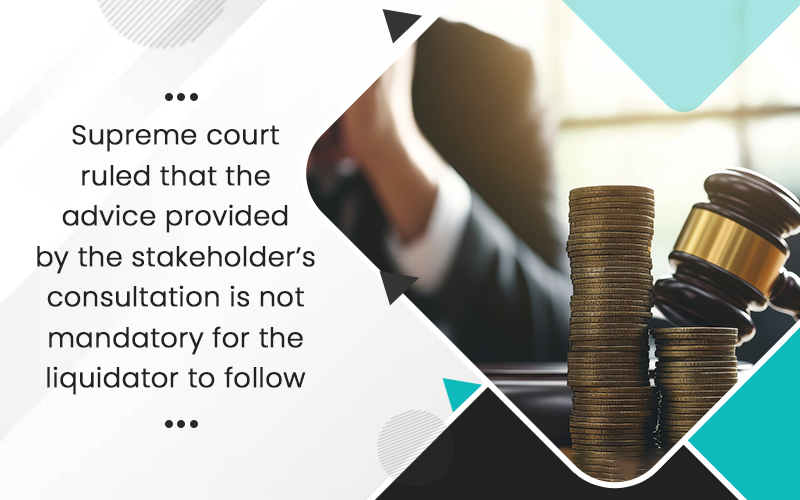
The Supreme Court recently addressed a legal dispute involving the interpretation of Rule 12 and Rule 13 under the Insolvency and Bankruptcy Board of India (Liquidation Process) Regulations, 2016 (IBBI Regulations), highlighting key distinctions in their application. The case arose from appeals challenging the National Company Law Appellate Tribunal (NCLAT) decision in Chennai, which dismissed an application seeking directions to the Liquidator. The Bench, consisting of Justice Hima Kohli and Justice Ahsanuddin Amanullah, clarified that Rule 12, which mandates specific timeframes for payment, is independent of Rule 13, which outlines the sale completion process. The Court emphasized that Rule 12 imposes strict consequences for non-compliance, such as the cancellation of the sale if the full payment is not made within the 90-day deadline. However, Rule 13, which deals with procedural steps for sale completion, does not impose penalties for non-compliance and should be considered directory rather than mandatory.
The case involved M/s Sri Lakshmi Hotel Private Limited, whose corporate debtor status led to liquidation proceedings after a financial dispute. The hotel had taken a loan from a creditor and, following disputes, the creditor invoked arbitration. In 2014, an arbitration award of Rs. 2,21,08,244/- was issued in favor of the creditor, which the company challenged unsuccessfully in court. With no payment forthcoming, the creditor initiated the Corporate Insolvency Resolution Process (CIRP) under the Insolvency and Bankruptcy Code (IBC). The company was subsequently liquidated, and a second auction was conducted, where KMC Speciality Hospitals emerged as the sole bidder. Under Rule 12 of the IBBI Regulations, the successful bidder must pay the balance sale consideration within 90 days. The appellant, a shareholder and former director of the company, sought to annul the auction but was unsuccessful before both the Adjudicating Authority and the NCLAT. The appellant then approached the Supreme Court.
The Supreme Court ruled that since Rule 12 clearly stipulates the payment deadline and the consequences of non-payment, it is mandatory in nature. In contrast, Rule 13, which outlines the steps for completing the sale, does not attach penalties for non-compliance and is therefore considered directory. The Court also noted that the successful bidder, KMC Speciality Hospitals, had sufficient time to complete payment before the onset of the Covid-19 pandemic but chose to delay the payment. Despite this delay, the auction was not canceled, as the Court found no evidence of fraud or significant irregularities in the auction process. The Court also considered the broader public interest, noting that KMC had built a fully operational 200-bed Mother and Child hospital on the auctioned land, benefiting seven surrounding districts. In light of this, the Court opted not to void the sale but directed the Auction Purchaser to pay an additional sum for the property. The Supreme Court’s decision thus balanced the equities involved, considering both legal compliance and the larger public interest served by the hospital project.