UNION OF INDIA & ORS. [APPELLANTS] Vs. COL. RAHUL ARORA [RESPONDENT]
CIVIL APPEAL NO. 2459 OF 2017
(2JB, PRASHANT MISHRA and PRASANNA VARALE JJ., delivered by PRASHANT MISHRA, J.)
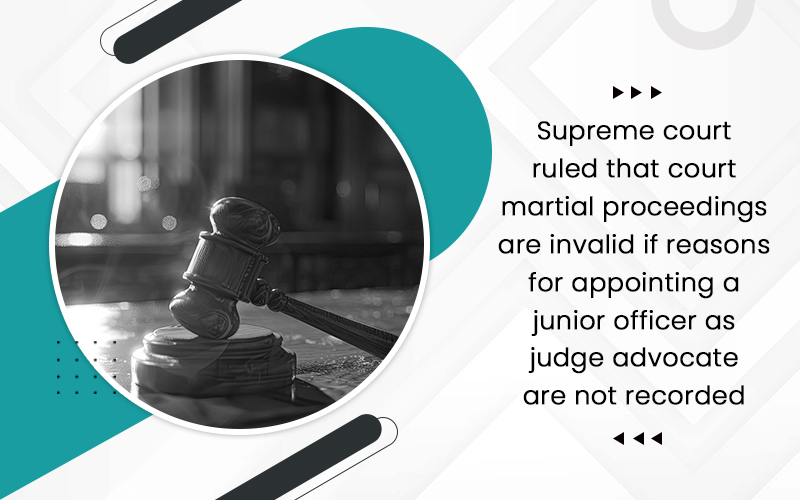
In a ruling on September 9, 2024, the Supreme Court of India declared that the non-recording of reasons for appointing a junior officer as the Presiding Officer of a Court Martial invalidates the proceedings. The case in question involved the Union of India and the appointment of a junior officer to preside over the Court Martial of a superior officer without proper justification, leading to legal scrutiny. The case referenced by the Supreme Court was Union of India & Anr. vs. Charanjit Singh Gill (2000), a key precedent that established the legal requirement for explaining why a junior officer is appointed as the Presiding Officer of a Court Martial. The Court ruled that unless it is explicitly recorded that, due to the demands of public service, no officer of equal or superior rank to the accused is available to act as Judge Advocate, a junior officer cannot preside over the Court Martial. Failing to provide these reasons invalidates the proceedings.
In this particular case, a junior officer was appointed to preside over the trial of a superior officer. However, the letter convening the officer’s appointment did not provide reasons for appointing a junior officer. After the letter had already been dispatched and received by the concerned military headquarters, the letter was modified to include reasons for the appointment. The Armed Forces Tribunal (AFT) upheld the Court Martial’s proceedings, but the Punjab and Haryana High Court overturned this decision, citing procedural flaws. Affirming the High Court’s decision, the Supreme Court upheld the principle that once a convening order is dispatched, it cannot be altered or modified unless there is a clear, documented mistake that requires correction. Any alteration made after dispatch, without following proper procedure, is deemed unauthorized and invalid. The Supreme Court noted that in this case, no legitimate reason for appointing the junior officer had been documented before the letter was sent, and the subsequent modification was unlawful.
The Supreme Court’s ruling emphasized that the process of appointing officers in a Court Martial must strictly adhere to the legal framework established in the Charanjit Singh Gill case. The Court observed that after a document is signed and dispatched, it cannot be changed unless a specific error is identified and justified for correction. In this case, no such justification was provided before the letter’s dispatch, and any changes made afterward were considered impermissible. The Court concluded that the Court Martial had committed an error by allowing a junior officer to preside over the case of a superior without proper legal authorization. The failure to record the required reasons for the appointment in the original convening order rendered the entire proceeding invalid. As a result, the Supreme Court dismissed the Union of India’s appeal and upheld the High Court’s decision, thereby nullifying the Court Martial’s proceedings. This ruling reinforces the importance of strict adherence to procedural rules in military trials, especially concerning the appointment of presiding officers, and highlights that deviations from established legal requirements cannot be rectified post-facto.