KATIYA HAIDARALI AHMADBHAI & ORS. [Appellant(s)] Vs. SANJEEV KUMAR IAS & ORS. [Respondent(s)]
CIVIL APPEAL NO.229 OF 2024
(3JB, ABHAY S.OKA, AHSANUDDIN AMANULLAH and AUGUSTINE GEORGE MASIH JJ.)
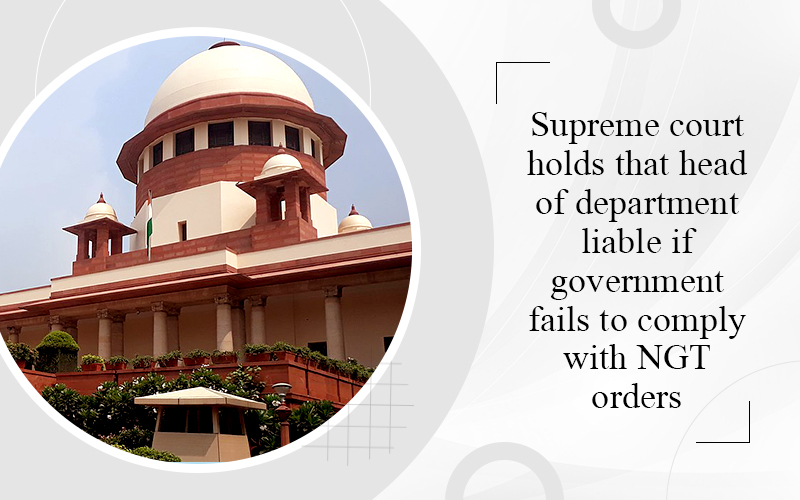
In a significant ruling, the Supreme Court of India recently emphasized the accountability of government departments in complying with orders issued by the National Green Tribunal (NGT). The court ruled that if a government department fails to implement an NGT order, the Head of the Department will be held liable for the failure as per Section 28 of the National Green Tribunal Act, 2010. This provision makes the department head automatically guilty, through legal fiction, in cases of non-compliance, subjecting them to potential legal proceedings.
The Supreme Court bench, consisting of Justices Abhay Oka, Ahsanuddin Amanullah, and Augustine George Masih, set aside an NGT order that had deleted 15 government officers from an execution application. This application was filed to address non-compliance with an NGT directive aimed at curbing unauthorized activities within the Wild Ass Sanctuary, located in Gujarat’s Rann of Kutch. The activities in question included illegal salt harvesting and fishing, which were detrimental to the wildlife sanctuary.
The issue originated from a 2020 NGT order passed in an original application against the Union of India. The NGT had directed the authorities to prevent illegal encroachments and ensure that no leases were granted for activities within the sanctuary without obtaining the necessary approvals from the National Board of Wildlife and the Forest and Environment Department. Additionally, the tribunal prohibited any unauthorized activities within a 10 km radius of the sanctuary.
In 2023, an appellant filed an execution application, alleging that 15 government officers had failed to comply with the NGT’s 2020 directive. The appellant sought legal action against these officers for their non-compliance. The NGT, however, directed the appellant to remove the names of these officers from the execution application. The tribunal argued that since these officers were not listed as respondents in their individual capacities in the original application, they could not be held accountable in the execution proceedings. Instead, the NGT suggested that the appellant include only those respondents who were named in the original application.
Aggrieved by this decision, the appellant approached the Supreme Court. The Supreme Court, upon hearing the matter, ruled that the NGT had erred in interfering at the stage of issuing notice to the officers. The court observed that it was inappropriate for the NGT to preemptively exclude the officers from the proceedings. According to the Supreme Court, once a notice had been issued, the officers could have come forward to present their defenses, including the argument that they were not responsible for ensuring compliance with the NGT’s order.
The apex court clarified that its ruling did not decide whether the officers were indeed responsible for violating the NGT’s 2020 order. Instead, the court left this determination to the NGT, instructing it to issue notices to the 15 government officers and allowing them the opportunity to present their case.