National Insurance Co. Ltd. {Appellants } Vs. Rathlavath Chandulal and Ors. {Respondent(s)}
Civil Appeal Nos. 490-491 of 2026 Arising Out of SLP(C) No(S). No. 3255-3256 of 2026
(SJB, Delivered by Rajesh Bindal, J.)
Overview
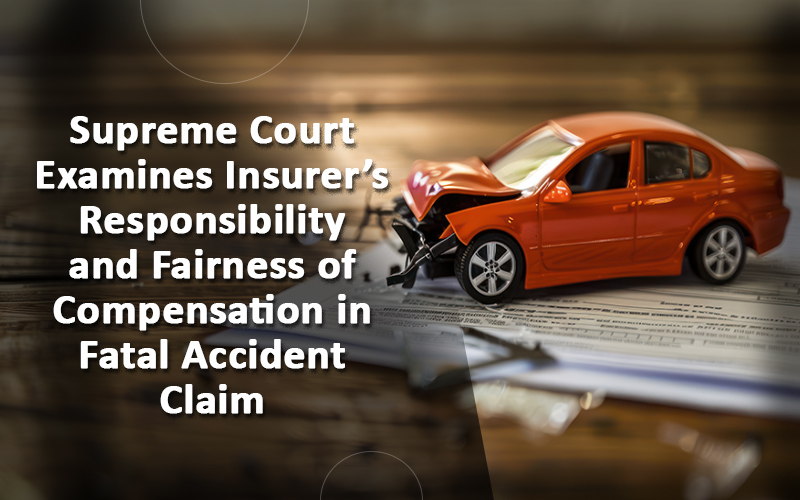
The matter came up before the Apex Court as a claim for compensation arising from a road accident. The dispute arose from two issues. First being whether the insurance company could avoid paying the compensation on the basis of the violation of the terms of the policy, and second, whether the amount granted to the family was properly calculated through just and reasonable means.
It was required of the Supreme Court to carefully address both the facts and the law governing motor accident claims. The case portrays the efforts made by the Court to balance defences raised by insurers based on technicality with the main purpose of law for compensation, ensuring that the families affected by road accidents receive fair and efficient relief.
Facts
The matter arose from an accident involving a vehicle insured with National Insurance Co. Ltd.. After the victim passed away, his family approached the Motor Accident Claims Tribunal for compensation. The deceased was the sole bread earner of the household. The claimants showed certain documents to the tribunal as to the age, occupation, and income of the deceased and asked for compensation for loss of income and other expenses.
The insurance company refused to go through with the claim. It was argued that the driver didn’t had a valid driving licence at the time of the accident which was a violation of the policy conditions as per the insurer. Due to the same, the company argued that it should not be made responsible for paying compensation to the family.
The Tribunal after examining the evidences produced by both the sides, found that the reason behind occurrence of such an accident was due to the driver’s negligence. It granted the compensation based on the standard law practice taken into consideration for the calculation of the compensation in such cases, which considers the income and age of the deceased and the number of dependants. The insurance company was ordered by the Tribunal to pay the amount as decided. This decision was further challenged before the High Court, but the company did not receive relief as requested. The matter was then taken to the Supreme Court.
Legal Issues
- Whether the insurer company can fully avoid paying the compensation if there exists a policy violation?
- Whether the compensation granted on the basis of standard legal practice, properly calculated?
- Whether the insurer could be ordered to pay the claimants first and then recover the amount from the vehicle owner?
Decision
The Supreme Court properly clarified that when an insurance company while defending itself based on breach of policy, must prove it with a solid and clear evidence. A simple statement by saying that one of the policy condition was violated was not enough in such matters. The burden of proof lies entirely on the insurer. It was also observed even if a breach of policy is proved, the insurer is still liable to pay the compensation to the claimants first and then the amount can be recovered from the owner of the vehicle. This approach ensures that victims are not left without remedy due to disputes between the insurer and the insured.
On the question of compensation, the Court stated that the amount gramted must be fair and reasonable. It should be proportional to the loss suffered by the family.
In short, the case clarifies that the purpose of compensation law when it comes to motor accidents, is meant to provide appropriate relief to the families affected by the same, and objections based on technicalities cannot be placed above that unless it is properly proved.