Horrmal (Deceased) through his LRs and others [Appellant(s)] Vs. State of Haryana and others [Respondent(s)]
Civil Appeal Arising out of SLP (C) No. 7963 / 2023
(2JB, SURYA KANT and K.V. VISWANATHAN JJ.)
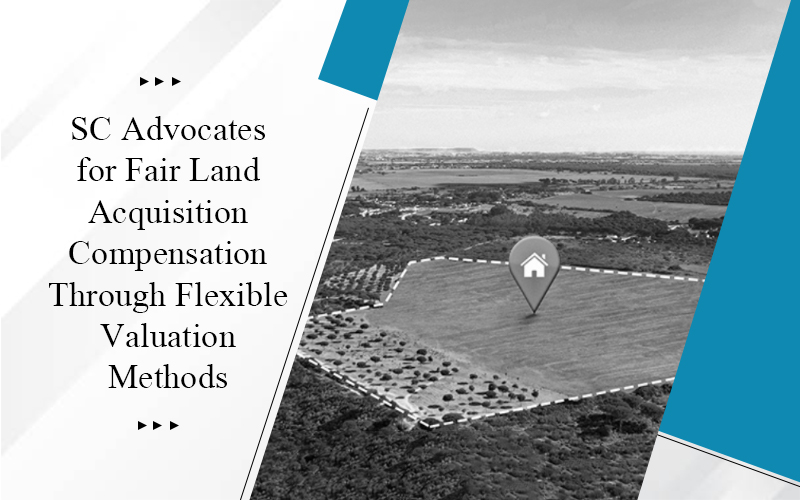
On October 21, the Supreme Court made a significant observation regarding the determination of compensation for land acquisition cases. The Court noted that when assessing fair and just compensation for acquired land, the sale of smaller plots could serve as valid exemplars, especially when they represent the best available evidence. This decision has broad implications for how compensation is calculated under the Land Acquisition Act and reaffirms the flexibility that courts can apply when interpreting market value and compensation fairness. The case involved multiple sale deeds of smaller plots, which the claimants argued represented a more accurate market reflection for the larger tract of land acquired. In its judgment, the Court clarified that no legal barrier exists to using these smaller land sales as reference points, provided they offer a genuine assessment of the land’s market value. According to the Court, there is no legal impediment to accepting such data as evidence for compensation estimation; instead, this method might better reflect true market conditions, especially in areas where larger parcel transactions are infrequent or non-existent.
In the past, there has been debate over whether smaller plots should be used to estimate the value of larger parcels of land, as smaller plots may yield higher per-unit prices due to accessibility or usability advantages. However, the Supreme Court’s latest decision underscores that each case should be examined on its own merits, with fairness and practicality as guiding principles. Where smaller plot transactions are the only or best available market data, they may indeed be more relevant than dated or unrepresentative sales of larger plots. This ruling also aligns with judicial precedent that emphasizes fair compensation under the Land Acquisition Act. The Supreme Court has previously recognized the need for adaptability in determining compensation, as seen in cases like Special Land Acquisition Officer v. M.K. Rafiq Saheb (1997), where it was established that the goal of compensation law is to ensure justice for landowners. The use of smaller land sales thus serves as a flexible approach that allows courts to base decisions on the best evidence available, further aligning with the Act’s purpose of ensuring landowners receive fair market value.
The Court’s stance has broader implications for land acquisition cases across India, especially in rural and semi-urban areas where land transactions might vary widely in size and price. By recognizing smaller land sales as valid comparables, the judgment accommodates the diversity of land markets, particularly in areas where larger tract sales are uncommon or difficult to price accurately. For instance, agricultural areas transitioning to residential or commercial development often see a patchwork of smaller transactions, making it essential for courts to consider these when larger land sale examples are unavailable. In addition, the ruling underscores the principle that the valuation process must be evidence-based, transparent, and fair, addressing both the interests of landowners and the practical realities of the market.