Kavita [Appellant] Vs. State of Haryana [Respondent]
CRA-S-4648-SB-2016
(CORAM: HON’BLE MRS. JUSTICE MANJARI NEHRU KAUL)
Facts: CRA-S-4648-SB-2016 has been filed by appellant-Kavita (hereinafter referred to as ‘accused’) to impugn the judgment of conviction dated 25.11.2016 and order of sentence dated 30.11.2016 passed by learned Additional Sessions Judge, Gurgaon whereby she was sentenced to undergo RI for a period of 05 years and to pay a fine of Rs.10,000/- under Section 306 of the IPC and in default of payment of fine, to further undergo RI for 2 ½ months, in case FIR No.23 dated 07.05.2013 under Section 306 of the IPC registered at Police Station GRP, Gurgaon.
Issue: Whether the present appeal is maintainable or not?
Arguments on behalf of counsel for appellant:
Learned counsel for the accused vehemently contends that there exists no evidence, either direct or indirect, to substantiate the charge against her under Section 306 of the IPC regarding her alleged involvement in her husband’s suicide. Furthermore, learned counsel has emphasised that in fact, there is complete absence of any discernible act much less mens rea, on the part of the accused, immediately preceding the suicide of her husband which could reasonably be construed as instigation. While referring to provisions of Sections 107 and 306 of the IPC, it has been further argued that in order to attract the ingredients of abetment of suicide there must be a deliberate or explicit act on the part of an accused, compelling the deceased to be left with no other alternative but to end his own life.
Arguments on behalf of counsel for respondent:
The State Counsel and learned counsel for the complainant while opposing the submissions of the learned counsel for the appellant/accused have advanced the arguments that the accused, a Delhi Police Constable, subjected the deceased to continuous mental and physical torture including character assassination. The suicide notes left behind by the deceased strongly suggested feelings of hopelessness because of the maltreatment by his wife i.e. the accused. Despite earnest efforts by the deceased to reconcile, the accused kept threatening and humiliating him, even poisoning him once, as also mentioned in the suicide note and in the FIR, which was lodged by the father of the deceased, after the suicide. Learned counsel have asserted that these actions clearly amounted to abetting suicide of the deceased.
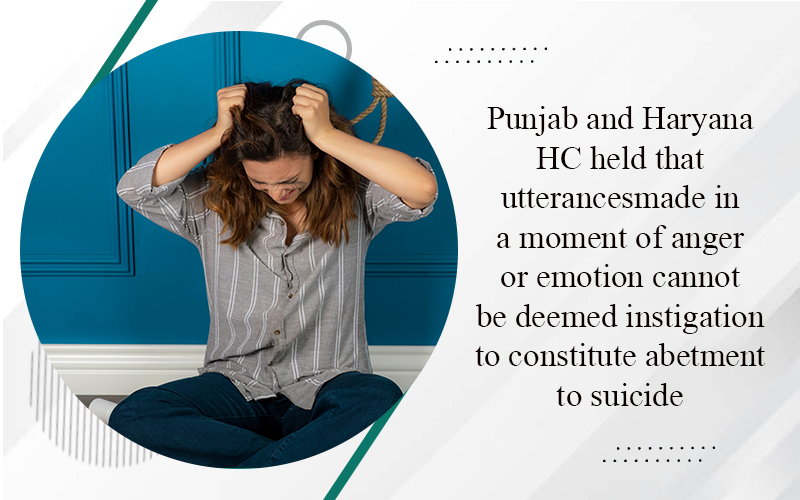
Held: The court allowed the present appeal and held that, “Possibility of the deceased being highly sensitive and choosing to commit suicide due to marital discord with the accused, who had admittedly been living apart from him for at least 10 days prior to the suicide, can be said to be a plausible circumstance leading to the suicide. The case of the prosecution thus, does not meet the criteria for abetment as defined under Section 107 of the IPC.”