RENEWFLEX RECYCLING [Petitioner] Vs. FACILITATION CENTRE ROHINI COURTS & ORS [Respondents]
W.P.(C) 2039/2025 & CM APPL. 9604/2025
(HON’BLE THE CHIEF JUSTICE and HON’BLE MR. JUSTICE TUSHAR RAO GEDELA)
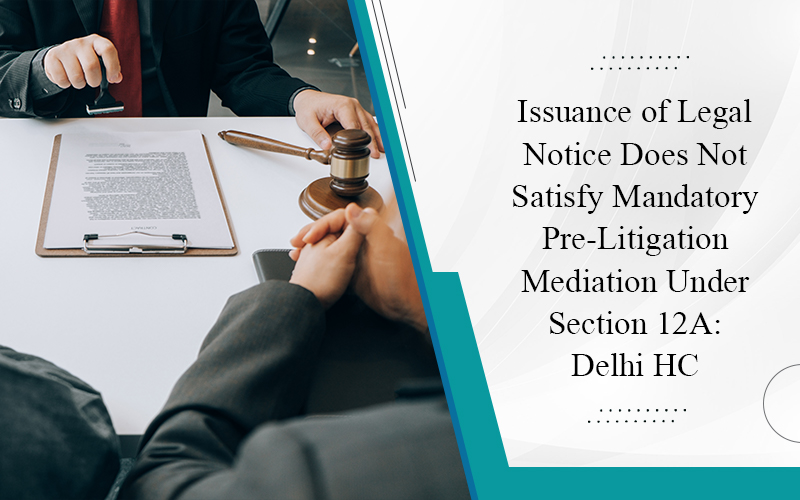
The Delhi High Court has ruled that issuing a legal notice calling for mediation does not satisfy the mandatory pre-litigation mediation requirement under Section 12A of the Commercial Courts Act, 2015. The ruling underscores that mediation must take place within the statutory framework established by the Legal Services Authorities Act, 1987, and not through informal or unilateral notices. The case arose when the petitioner, a supplier of goods, did not receive payment from the respondent despite multiple reminders and invoices. The petitioner sent a legal notice on December 21, 2024, requesting mediation on December 24, 2024. However, the respondent did not respond. Subsequently, the petitioner filed a commercial suit in January 2025, but the Registry rejected it for non-compliance with Section 12A. This provision requires obtaining a certificate or a non-starter report from an authorized mediation authority before initiating a commercial suit, confirming that mediation has been attempted but was unsuccessful.
A Division Bench comprising Chief Justice Devendra Kumar Upadhyaya and Justice Tushar Rao Gedela examined the issue and ruled against the petitioner. The Court emphasized that a plain reading of Section 12A does not suggest that a legal notice issued by an advocate calling for mediation meets the requirement of statutory pre-litigation mediation. The intent of the provision is to ensure that mediation is conducted within the statutory framework to prevent unnecessary prolongation of commercial litigation. During arguments, the petitioner contended that sending a legal notice requesting mediation and the respondent’s failure to respond should be deemed sufficient compliance with Section 12A. It was further argued that insisting on a non-starter report from an authorized mediation authority would create an unnecessary procedural hurdle, thereby delaying access to justice and violating fundamental rights under Articles 14 and 21 of the Constitution.
However, the Court rejected these arguments, calling them “completely misconceived” and based on a misunderstanding of Section 12A. It clarified that while a litigant may issue a legal notice suggesting mediation, such an action is not recognized under the statutory framework and remains outside the realm of legal obligations under the Act. The Court reiterated that Section 12A mandates mediation through the proper statutory mechanism, and informal attempts do not fulfill its requirements. Consequently, the petition was dismissed, reinforcing that compliance with Section 12A is essential for the admissibility of commercial suits. The ruling highlights the importance of adhering to procedural requirements for pre-litigation mediation, ensuring that commercial disputes undergo a structured resolution process before reaching the courts.