Rajubhai Kalidas Chunara {Applicant(s)} Vs. Kantibhai Kalyanjibhai Shah & Anr. {Respondent(s)}
R/Criminal Revision Application No. 984 of 2016
(SJB, Delivered by Hasmukh D. Suthar, J.)
Overview
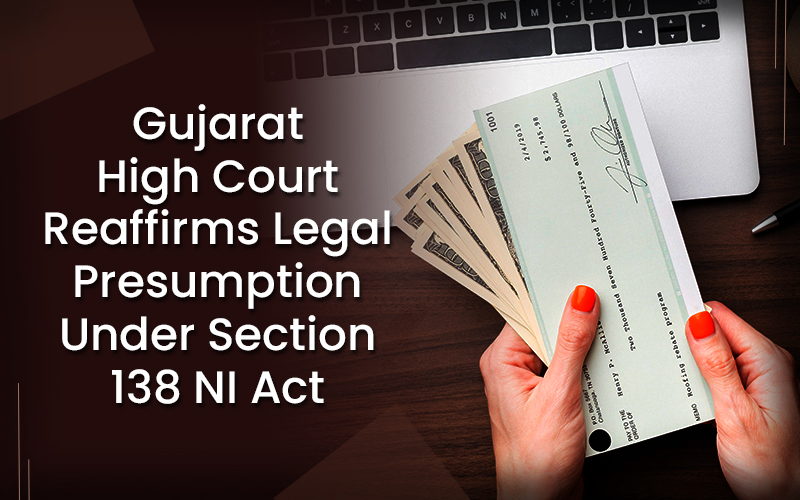
In this case, a challenge came before the Gujarat High Court against a conviction for dishonour of a cheque under Section 138 of the Negotiable Instruments Act. The applicant was already held guilty by both trial court as well as the sessions court. He then approached the High Court in order to get the decision reversed.
The High Court clarified that it would not go through the entire case again, but would see whether any serious legal error or injustice had occurred in the decision of the courts below. The main questions to be addressed were as to whether the cheque was issued for a genuine debt, whether proper legal notice was issued, and whether the accused succeeded in defending himself properly against the legal presumption that usually exists in such cases.
Facts of the Case
The complainant, who is a professor, had known the applicant since 1995. In years between 2006 and 2010, he gave the applicant some money as a personal loan, adding up to ₹3,50,000. To repay this amount, the applicant issued a few cheques. Later, those were replaced by two fresh cheques dated 4 April 2012. One for ₹1,50,000 and the other for ₹2,00,000. The complainant was asked by the applicant to deposit these cheques after the mango season, since he was involved in this business. During that time, he made small payments of ₹5000 and ₹7000 in cash. However, when the complainant asked for the remaining amount, things became a little tense. The applicant even threatened to commit suicide, which forced the complainant to approach the police.
Eventually, the complainant in August 2012 deposited the cheques but they were returned due to “insufficient funds.” Following the same, a legal notice was sent to the applicant. Even after receiving it, neither did the applicant reply to the notice nor did he make any payments. Due to this, the complainant was left with no other choice than to file a case under section 138 of the Negotiable Instruments Act.
The trial court concluded that the applicant was at fault and sentenced him to 3 months imprisonment along with compensation. The Sessions Court upheld this decision.
Legal Issues
- Whether the statutory legal notice was served properly, despite the applicant denying the same.
- Whether the complainant was successful in proving that there exists a legally enforceable debt.
- Whether the payments made in small portions affected the validity of the amount of the cheque under Section 56.
- Whether the High Court could re-examine the evidence while exercising its powers as to revision.
Decision
The Gujarat High Court upheld the orders passed by the courts below. It held that once the applicant admits that the cheque is signed by him, the law presumes that they were issued for the purpose of repayment of a debt. The burden of disproving the same then shifted towards the applicant, and he failed to do so.
The court rejected the argument as to the notice not being served appropriately, stating that when a notice is sent to a correct address, it is legally presumed that it has been properly served. The silence of the applicant after receiving the notice was considered to be a weak point for his case.
As to the part payment, the court observed that the payments were not shown to be directly linked to the cheques, therefore, no benefit could be claimed for the same.
Finally, it was emphasised that the powers as to the revision are limited and cannot be used to reassess any facts or evidence, unless there is an error on the face of it. As no such defect was found, the court directed the applicant to surrender and serve the remaining sentence.