SH VIJAI PRATAP SINGH [Petitioner] Vs. DELHI HIGH COURT, THROUGH REGISTRAR GENERAL & ANR [Respondents]
W.P.(C) 2045/2025
(CORAM: HON’BLE THE CHIEF JUSTICE & HON’BLE MR. JUSTICE TUSHAR RAO GEDELA)
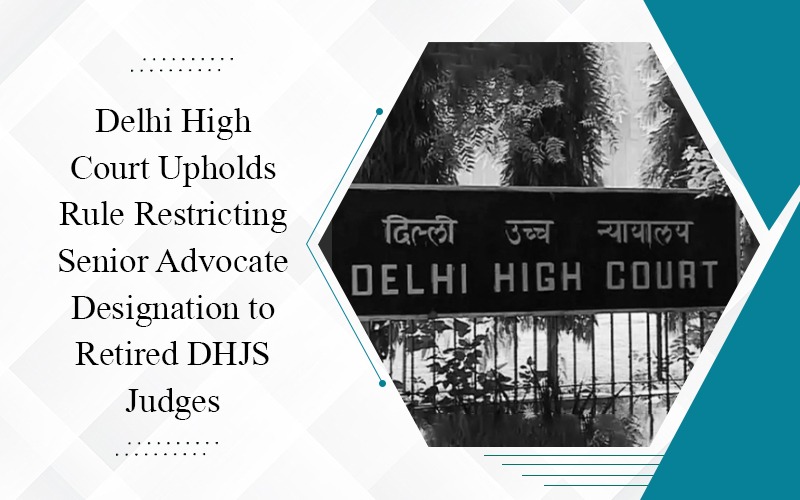
The Delhi High Court has upheld Rule 9B of the High Court of Delhi Designation of Senior Advocate Rules, 2024, which restricts the eligibility for senior advocate designation to retired judicial officers of the Delhi Higher Judicial Service (DHJS) with at least ten years of service. The rule bars retired judges from other states from applying for the designation, leading to a legal challenge by a retired judge from the Uttar Pradesh Higher Judicial Service (UPHJS). The petitioner argued that this rule was arbitrary and discriminatory, violating Articles 14, 19(1)(g), and 21 of the Indian Constitution.
A Division Bench comprising Chief Justice Devendra Kumar Upadhyaya and Justice Tushar Rao Gedela dismissed the plea, ruling that the classification was based on intelligible differentia and served a legitimate purpose. The court reasoned that the designation of a Senior Advocate is not an inherent right but a privilege conferred upon advocates who have demonstrated exceptional legal expertise and contributions to the legal profession.
The court emphasized that Rule 9B does not prevent a retired judicial officer from practicing law in any court, including the Supreme Court. Therefore, the petitioner’s argument that the rule violated Article 19(1)(g) (freedom to practice any profession) was deemed baseless. The court clarified that the process of conferring senior advocate status involves a subjective assessment of professional standing, legal acumen, and reputation, which are primarily evaluated by the judges of the concerned High Court. Given this, expecting Delhi High Court judges to assess retired judicial officers from other states—who may not have been closely observed by them—was considered impractical.
The judgment further elaborated on the distinct evaluation process for retired DHJS judges. Unlike practicing advocates, retired judicial officers are assessed based on their past judicial performance, Annual Confidential Reports (ACRs), and Annual Performance Appraisal Reports (APARs), which are readily available to the Delhi High Court. This makes it feasible for the court to evaluate DHJS officers but not those from other states.
The petitioner had contended that excluding retired judges from other states was unfair, especially those who regularly practiced before the Delhi High Court. However, the court held that the rule was not an impediment to their practice. The status of a senior advocate is a mark of distinction rather than a necessity for legal practice. It does not grant any exclusive rights but only privileges within the legal profession.
The court also highlighted that senior advocate designation carries a stature comparable to that of a High Court judge. Given the significance of this evaluation, the distinction between DHJS officers and retired judges from other states was justified. The ruling reaffirmed that the selection process involves subjective considerations of legal competence and professional reputation within the Delhi legal fraternity, reinforcing the rationale for maintaining the existing classification.
Ultimately, the court upheld the rule, reiterating that while the designation of Senior Advocate is an honor, its absence does not constitute discrimination or limit a lawyer’s right to practice law.