OBI OGOCHUKWA STEPHEN [Petitioner] Vs. STATE OF NCT OF DELHI [Respondent]
BAIL APPLN. 4056/2023 & CRL.M.A. 12790/2024, CRL.M.A. 23372/2024
(ANUP JAIRAM BHAMBHANI J.)
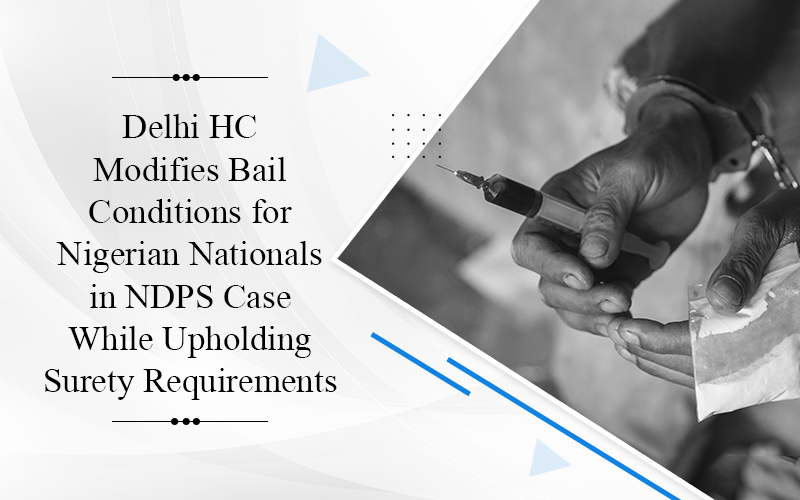
In a recent ruling, the Delhi High Court addressed applications from two Nigerian nationals facing charges under the Narcotic Drugs and Psychotropic Substances (NDPS) Act, 1985. The petitioners sought modifications to their bail conditions, arguing that they were unable to fulfill the existing requirements outlined in their respective bail orders. Justice Anup Jairam Bhambhani presided over the case and assessed the requests, ultimately finding no justification for waiving the surety requirement or allowing cash deposits instead of surety. However, in a move to accommodate the petitioners, the Court modified the bail conditions. The first petitioner was allowed to provide a personal bond with one surety in the amount of ₹40,000, reduced from two sureties totaling ₹1,00,000. Similarly, the second petitioner was permitted to submit a personal bond with one surety for ₹25,000, lowered from the previous requirement of ₹1,00,000. Both petitioners, who entered India on expired visas, currently reside in the country illegally. The Foreigners Regional Registration Office (FRRO) reported that the first petitioner had overstayed his visa since 2011 and allegedly used forged documents, prompting a Look-Out Circular against him. The second petitioner had also overstayed for about 12 years after his visa expired in 2012 and had been granted bail on September 26, 2023.
The Court considered several questions: Can a court completely eliminate the need for a surety bond? Is it permissible to allow cash deposits instead of requiring a person to sign a bond ensuring the accused’s availability for court proceedings? If the answers to these questions are affirmative, should such waivers be granted casually, or should they be carefully considered, especially in cases involving foreign nationals who are illegal residents? The Court noted that the legal framework in India has established that once bail is granted, it should not be revoked solely due to an individual’s inability to meet financial requirements. It is also recognized that if a person cannot produce a surety—typically someone willing to sign a bond to guarantee the accused’s appearance—this requirement may be substituted with a cash deposit or other valuable security. The rationale behind requiring a surety stems from the fundamental principle of bail, which seeks to ensure that the accused remains available for trial.
The Supreme Court has previously asserted that foreign nationals should not be treated differently from Indian citizens regarding criminal offenses. However, the conditions for bail must be more stringent for foreign nationals, particularly concerning the necessity of providing two sureties, to mitigate flight risks and ensure compliance with court proceedings. In conclusion, the Delhi High Court ruled against the petitioners’ requests for waiving the surety requirement due to their status as overstayers without credible evidence of financial hardship. Nevertheless, the Court modified their bail conditions to reduce the surety amounts, balancing the need for compliance with the judicial process and the petitioners’ individual circumstances. The Court reiterated that the surety bond requirement is crucial for upholding the integrity of the judicial system, and simply allowing a cash deposit would not serve its intended purpose.