M/s ABS Marine Services {Appellant(s)} Vs. The Andaman and Nicobar Administration {Respondent(s)}
Civil Appeal No(S). 3658-3659 of 2022
(SJB, Delivered by K.V. Viswanathan, J.)
Overview
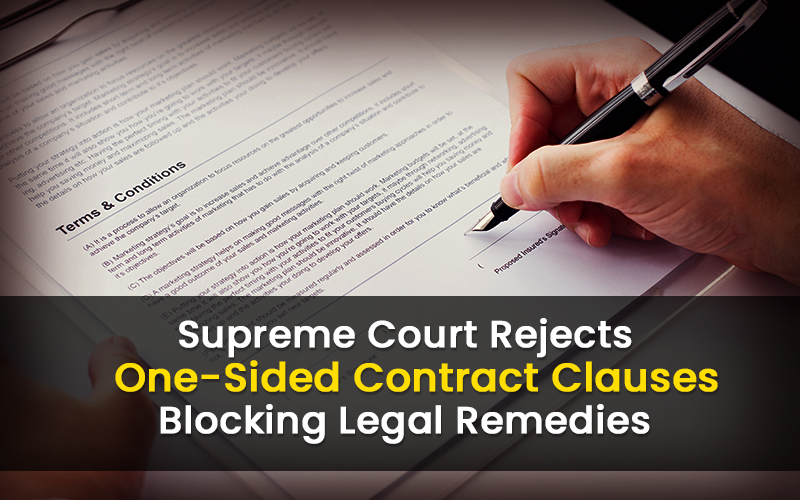
In this case, the Supreme Court examined whether a contract can completely restrict the legal remedies available, when one party is a government authority.
The dispute arose from two clauses in the agreement between the parties. First clause, 3.20, giving the Administration final authority over the disputes, and second, 3.22, allowing for arbitration.
The High Court earlier held that the dispute was an “excepted matter” and therefore outside the scope of the arbitrator. However, the Apex Court raised doubt as to whether such a clause could allow one party to act as a judge in its own case without any further challenge. A basic legal principle was referred for the same i.e., every legal right must have a legal remedy. This was to clarify that the terms of a contract should not be interpreted in such a manner that access to justice is completely denied.
Facts
The appellant, ABS Marine Services and the respondent, Andaman and Nicobar Administration, entered into a Manning Agreement on 26 December 2008. Under this agreement, the appellant was responsible for providing officers for 17 vessels and in return would be payed monthly.
On 6 July 2009, one of the vessels, M.V. Long Island, hit a rock due to bad weather conditions and suffered heavy damage. Four years later, in February 2013, the Administration issued a show cause notice to the appellant alleging that they were negligent in performing the contract and imposed a penalty. The appellant denied the same.
Despite this, in September 2014, the Administration recovered ₹2.87 crores from the amount due on part of the appellant.
This led to a dispute which was referred to arbitration. At first, the respondent participated in the proceedings, but later argued that Clause 3.20 led to its decision being final and not open to any challenge in arbitration.
The arbitrator rejected this argument, passed an award in favour of the appellant and held that the clause was invalid. The District Judge, however, upheld the award, but later it was set aside by the High Court, concluding that the matter was not arbitrable.
Legal Issues
- Whether a party to a contract can act as a judge in its own case and decisions.
- Whether Clause 3.20 excluded all forms of legal challenge, including arbitration while making the Administration’s decision final in all situations.
- Whether Clause 3.20 and Clause 3.22 should be read together to avoid denial of any legal remedies.
- Whether completely excluding both, courts as well as the process of arbitration, violates legal principles as well as public policy.
Decision
The Apex Court set aside the decision of the High Court and ruled in favour of the appellant. It held that the reasoning by the High Court was incorrect and ignored basic legal principles. The Court also clarified that a contract cannot be interpreted in a manner that it leads to a party being left without any remedy. It relied on the principal that where there is a right, there must always be a remedy.
Allowing a government authority to take a final decision without any possibility of challenge is against the rule of law.
It was observed that Clause 3.20 of the agreement can only be applied in limited situations, such as when liability is accepted by the party and only the amount is in dispute. In the current scenario, since the appellant denied alleged negligence on its part, the dispute was completely open to arbitration under Clause 3.22.
It was further held that the clauses of a contract are not above access to justice. Since the arbitrator acted within the jurisdiction, making the award valid, there was no reason to interfere and the award was restored.