Section 125 Cr.P.C.
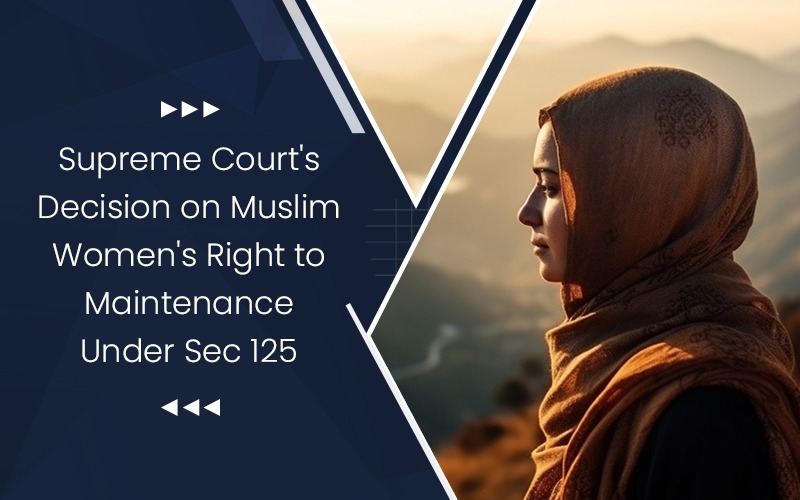
In a historic ruling on July 10, the Supreme Court of India declared that Muslim women can file for maintenance under Section 125 of the Code of Criminal Procedure (CrPC). This decision is a crucial move towards achieving gender justice and equality, transcending religious barriers within secular law. The bench, comprising Justices BV Nagarathna and Augustine George Masih, rejected a Muslim man’s plea against paying interim maintenance to his divorced wife under Section 125 CrPC. The Court firmly stated that the Muslim Women (Protection of Rights on Divorce) Act, 1986, does not supersede Section 125 CrPC.
The Verdict and Its Implications
Justice Nagarathna, in a separate but concurring judgment, remarked, “We are dismissing the criminal appeal with the conclusion that Section 125 CrPC would be applicable to all women and not just married women.” This reinforces the universal applicability of Section 125 CrPC, ensuring maintenance provisions for women regardless of their religion. Justice Masih agreed, highlighting that the CrPC’s secular nature guarantees maintenance rights for all women, irrespective of their faith.
Additional Remedies Under the Muslim Women (Protection of Rights on Marriage) Act, 2019
The bench clarified that if a Muslim woman is divorced while a petition under Section 125 CrPC is pending, she can also seek relief under the Muslim Women (Protection of Rights on Marriage) Act, 2019. This Act provides additional remedies, ensuring Muslim women have multiple ways to secure their rights. The judgment specifies that the 2019 Act supplements, rather than replaces, the remedy under Section 125 CrPC, offering comprehensive protection for divorced Muslim women.
Background of the Case
Contentions of the Petitioner-Husband:
- Special Nature of the 1986 Act: He argued that the Muslim Women (Protection of Rights on Divorce) Act, 1986, provides more comprehensive provisions than Section 125 CrPC, including maintenance, mehr, dower, and return of property. The Act mandates a “reasonable and fair” provision for the divorced woman for her entire life, unlike Section 125 CrPC.
- Prevailing Over General Law: He contended that the 1986 Act, as a special law, should prevail over the general law of CrPC, citing the legal principle that special laws override general laws. He stressed that the clear language of the 1986 Act should be implemented without interpretative analysis.
- Exclusive Remedies: He argued that Section 5 of the 1986 Act allows the divorced couple to opt out of the Act, indicating that a Muslim wife cannot use both remedies under the Act and Section 125 CrPC simultaneously.
- Transitory Provision: He pointed out that Section 7 of the 1986 Act requires any Section 125 CrPC petition pending at the time of the Act’s commencement to be disposed of under Section 3 of the Act, implying that Section 125 CrPC petitions for Muslim women should be interpreted in light of the 1986 Act.
Contentions of the Amicus Curiae:
- Constitutional Validity: He emphasized that the 1986 Act expands a divorced Muslim woman’s entitlement to maintenance beyond the iddat period but does not remove her right to relief under Section 125 CrPC. The purposes of both provisions are distinct yet complementary.
- Non-Exclusivity: He argued that Section 5 of the 1986 Act is relevant only when an application is filed under Section 3 of the Act. Since the respondent-wife approached the Court under Section 125 CrPC, the petitioner’s reliance on Section 5 is misplaced.
- Transitory Nature of Section 7: He contended that Section 7 is merely a transitional provision, ensuring that petitions pending under Section 125 CrPC at the Act’s commencement are governed by Section 3, without implying that new petitions under Section 125 CrPC cannot be filed by divorced Muslim women.
- Equality and Non-Discrimination: He highlighted that denying Muslim women the right to file petitions under Section 125 CrPC would be unconstitutional, as it would deprive them of the same rights available to other women in the country.
Court’s Observations and Reasoning
- Non-Obstante Clause and Additional Remedy- During the hearing, the bench noted that Section 3 of the 1986 Act begins with a non-obstante clause, indicating that it supplements, rather than conflicts with, Section 125 CrPC. Justice Masih remarked, “This Act does not bar…it is the choice of the person who had applied or moved an application under 125…there is no statutory provision provided under the Act of 1986 which says that 125 is not maintainable.” Justice Nagarathna agreed, stating that nothing in the 1986 Act bars one remedy in favor of the other.
- Consideration of Provision Made During Iddat Period-The bench inquired whether the petitioner-husband had made any provision for the respondent-wife during the iddat period. It was revealed that a draft of Rs. 15,000 was tendered but not claimed by the respondent-wife. The bench observed that had the petitioner made adequate provision during the iddat period, Section 127(3)(b) CrPC might have come into play, potentially altering the case dynamics.
- Interpretation of Section 7 and High Court Judgments- Responding to the petitioner’s argument that none of the cited judgments dealt with Section 7 of the 1986 Act, Justice Nagarathna clarified that the provision is transitional, applicable only to pending cases at the time of the Act’s commencement. The Amicus referred to a Kerala High Court judgment which held that Section 7 could not be interpreted as extinguishing the right of divorced Muslim women to file petitions under Section 125 CrPC. The High Court opined that Parliament’s intention was not to extinguish such rights, as the 1986 Act was meant to supplement, not supplant, the remedies available under Section 125 CrPC.
Conclusion
The Supreme Court’s ruling reaffirms the secular nature of Section 125 CrPC, ensuring that all women, including divorced Muslim women, have the right to seek maintenance. By clarifying the relationship between the Muslim Women (Protection of Rights on Divorce) Act, 1986, and Section 125 CrPC, the Court has reinforced the principle of gender justice. This judgment underscores the necessity of interpreting laws in a manner that upholds the constitutional values of equality and non-discrimination. The decision is a significant milestone in the pursuit of justice for women across religious boundaries, ensuring that legal remedies are accessible to all, irrespective of personal laws.