Lata [Appellant(s) ] Vs. Union of India & Anr. [Respondent(s)]
CIVIL APPEAL No. 9172 OF 2026
(@Special Leave Petition(Civil) No.30726 of 2025)
(DB, Before Sanjay Karol and Nongmeikapam Kotiswar Singh, JJ.)
Overview
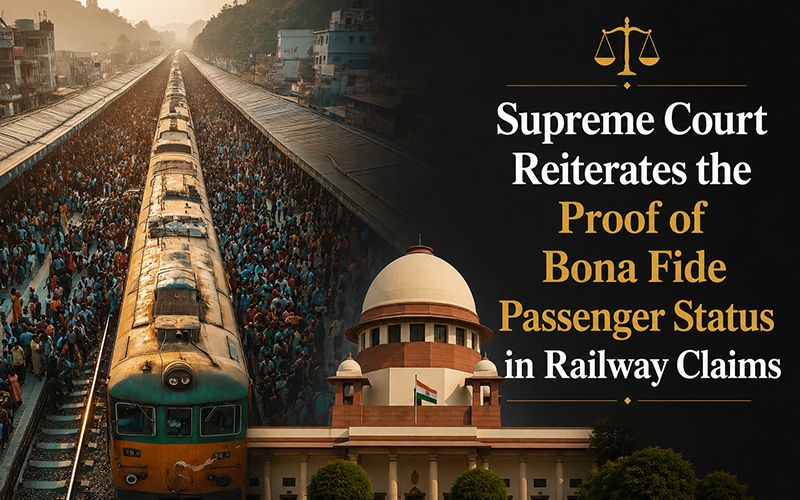
In this case, the Supreme Court examined the proof which is required to establish bona fide status of the passenger in a railway compensation claim. Section 124A of the Railways Act, 1989 creates a no-fault liability for death or injury caused by an untoward incident. It was held that if a travel ticket is absent, it does not mean that the compensation claim can be defeated automatically.
Facts of the Case
On 28 November 2015, Chandrakant Thakkar was travelling via Train no. 12834, from Raipur to Ahmedabad. He fell from the running train in the Khandbada-Khatgaon section and died due to severe injuries.
His wife, Lata, the appellant herein, filed a claim before the Railway Claims Tribunal, Bhopal Bench, for compensation of ₹4,00,000. She stated that travel ticket of her husband was in his luggage, which was misplaced and could not be traced.
The Tribunal accepted the death as an untoward incident, but rejected the claim since the bona fide passenger status was not proved.
The High Court of Madhya Pradesh upheld that decision on 3 January 2024. Following the same, the appellant approached the Supreme Court.
Legal Issues
- Whether the absence of a railway ticket is sufficient to conclude that the bona fide passenger status remains disproved.
- Whether the claimant can discharge the initial burden to prove that the deceased was a bona fide passenger through an affidavit.
- Whether the burden shifts to the Railway Administration to prove that the deceased was not a bona fide passenger.
- Whether the claims under Section 124A are governed by preponderance of probabilities rather than proof beyond reasonable doubt.
Decision
The Supreme Court allowed the appeals, set aside the decisions of the High Court and the Tribunal and awarded ₹8,00,000 to the appellant.
The Court held that the absence of a physical ticket doesn’t automatically mean that the person was not a bona fide passenger. Relying on the case of Union of India v. Rina Devi, it reiterated that the initial burden lies on the claimant, but it can be discharged through an affidavit stating proper facts. Once it is discharged, the Railway Administration must rebut the claim using the facts available.
The Court also emphasised that Section 124A is a beneficial provision which is based on no-fault liability. It requires a very liberal interpretation. The standard which is applicable is preponderance of probabilities and not proof beyond reasonable doubt.
The Supreme Court directed payment of ₹8,00,000 within four weeks after the appellant furnished her bank details. If the payment to be made was delayed, the amount would carry interest at the rate of 8% from 18 March 2016.