Messer Griesheim GmbH (Now Called Air Liquide Deutschland GmbH) {Appellant(s) } Vs. Goyal MG Gases Pvt. Ltd. {Respondent(s)}
CIVIL APPEAL NO. OF 2026 ARISING OUT OF SLP (C) NO. 4774 OF 2023
(DJB, P.S. Narasimha and Alok Aradhe, JJ.)
Overview
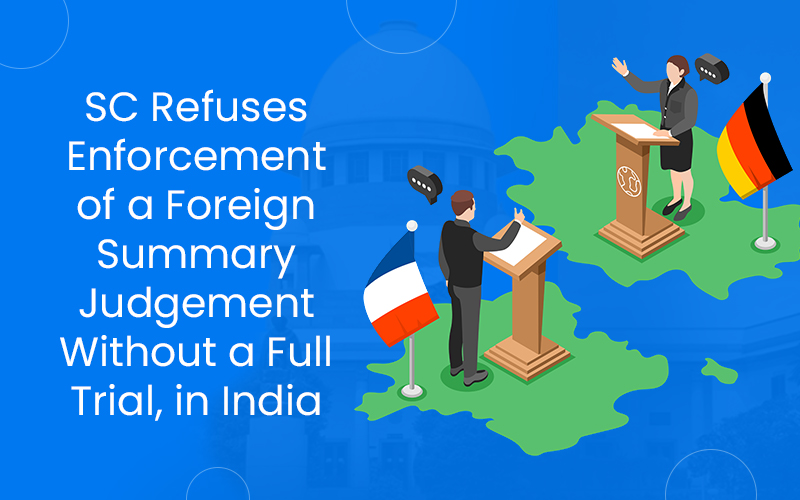
This case came before the Supreme Court in regards to the enforcement of a foreign judgement in India. The dispute arose when a German company wanted to execute a decree passed by an English court against an Indian company. The key issue was whether the judgement passed through a summary procedure without a full trial can be treated as final and binding under Indian law.
The Court had to examine the requirements under Section 13 and 44A of the Code of Civil Procedure, especially whether such a judgement can be said to be on merits. It was also analysed whether ignoring the Indian regulations, particularly those imposed by the Reserve Bank of India would affect the enforceability.
Facts of the Case
The issue began with a joint venture arrangement between both the parties in the 1990s for manufacturing industrial gases in India. To support this venture, Goyal MG Gases Pvt. Ltd., the respondent herein, obtained a foreign loan of USD 7 million from a UK bank. The appellant, Messer Griesheim GmbH, was a guarantor for the loan.
At that time, the foreign exchange transactions were regulated by FERA and RBI approval was required for the same. In this case, the RBI allowed the guarantee, but imposed a condition that if it was invoked, no liability would be imposed on the Indian company.
Later, the respondent failed to repay the loan amount, and the guarantee was invoked by the bank. The appellant paid USD 4.78 million and then asked the respondent for recovery of the amount.
Following the same, the appellant initiated proceedings in England. Initially, a default judgement was obtained but analysing the issues which might occur in India, it was set aside and was replaced with a summary judgement. The English Court refused the respondent to fully defend the case and passed a decree in favour of the appellant.
The respondent raised several defences, including oral agreements and records, portraying that the liability was adjusted against other claims. Despite the same, the English Court proceeded without a full trial.
When the appellant tried to enforce this judgement in India, the Delhi High Court rejected the enforcement. This led to an appeal before the Supreme Court.
Legal Issues
- Whether the foreign judgement can be considered as having been decided “on merits” under Section 13 of Code of Civil Procedure.
- Whether refusal to allow full defence, when it comes to genuine disputes, affects the enforceability.
- Whether ignoring the RBI conditions under FERA makes the decree contrary to Indian law.
- Whether judgement can be executed in India under Section 44A of Code of Civil Procedure.
Decision
The Supreme Court dismissed the appeal and refused the enforcement of the foreign judgement in India. The Court held that the judgement was not passed “on merits” since the English Court denied the respondent a proper opportunity to present its case despite the existence of a substantial dispute. It was observed that summary judgements should be used cautiously, especially when important facts require deep examination.
The Court also found that the procedure which was adopted denied the opportunity of fair hearing, which is against the basic principles of natural justice.
The Court noted that the RBI had clearly restricted any liability from being imposed on the Indian company. Ignoring this condition means that the decree was based on something which was not permissible under Indian law.
Therefore, the Court concluded that the foreign judgement failed to meet the conditions under Section 13 CPC and therefore could not be enforced in India.