Smt. Manju Chawla and Ors. Vs. Indore Municipal Corporation, Indore and Anr.
WRIT PETITION No.3547 of 2020
(SJB, Before Jai Kumar Pillai, J.)
Overview
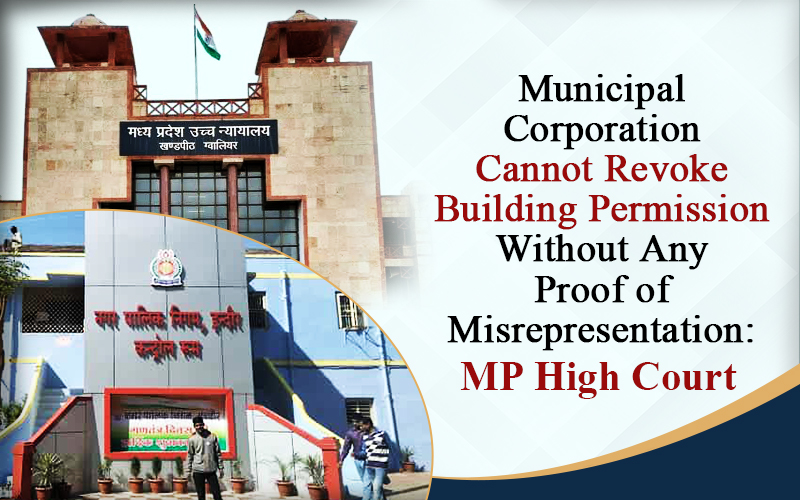
In this case, the Madhya Pradesh High Court examined a dispute as to the revocation of a building permission and further notices as to demolition issued by the Municipal Corporation of Indore.
The Court was approached by the petitioners under Article 226 of the Constitution, challenging the decision of the municipal authority to cancel a sanction, which is granted after proper scrutiny and upon which the construction had already been started.
The major issue to be dealt by the Court was whether a Corporation could invoke its power to revoke a building permission under the Madhya Pradesh Bhumi Vikas Rules, in absence of any record, showing fraud or any misrepresentation by the applicants.
This raised questions as to the fairness in administration, equality before law and the right to property.
Facts of the Case
The petitioners owned a property at Chain Singh Ka Bagicha, Indore. After it was mutated in their names, in July 2017, they applied for a building permission which was granted on 27 July 2017. The prescribed procedure was followed by the Corporation including the issuance of a public notice inviting objections.
Following the same, the petitioners invested a huge amount while relying on the validity of the sanction and proceeded with the construction. A three-storey structure had already been completed before the dispute arose. Later in February 2019, a show cause notice was issued by the Corporation alleging that while the plan sanctioned, reflected an 18-metre-wide road in front of the property, the Indore Master Plan contemplated a 30-metre-wide road.
The petitioners responded by saying that the building inspector of the Corporation itself verified the conditions of the site before making any recommendations as to the approval and that the properties close to the location had been sanctioned on the same basis.
Despite this explanation, the Corporation revoked the building permission on 9 May 2019, and demolition notices, prompting the present petition were issued later.
Legal Issues
- Whether M.P. Bhumi Vikas Rules could be invoked without proof of any false statement or misrepresentation by the applicants.
- Whether the Corporation could hold the petitioners responsible when its own officials inspected the site and approved the plan.
- Whether revoking the permission and issuing demolition notices amounted to unequal treatment.
- Whether cancelling a valid permission, after substantial construction was already completed, violated the right to property of the petitioner.
- Whether the Corporation’s delay in taking any action could justify the cancellation of the building permission later.
Decision
The writ petition was allowed by the High Court and the revocation order along with the demolition notices was quashed. It was held that there was absolutely no evidence to prove that the petitioners secured the permission through fraud or misrepresentation. On the other hand, the record showed that the officials of the Corporation itself had inspected the site and processed the application before the approval was granted.
The Court was also critical of the delay of the Corporation. It was observed that the authorities were inactive for almost 2 years while the petitioners changed their position and completed proper construction on the basis of a valid sanction. Such inaction, followed by an attempt to revoke the permission, could not be justified in the absence of any wrongdoing by the applicants.
Further, the Court found merit in the contention that the neighbouring properties received similar treatment under the same framework. The argument was therefore rejected by the Court as to the petitioners seeking the benefit of an illegality, and it was held that they were entitled to equal treatment.
The building permission was restored accordingly by the Court and the Corporation was restrained from taking coercive action based on the impugned orders, while giving certain clarification as to the future action to be strictly in conformity with law and free from any discrimination.