Jagadish R {Petitioner } Vs. Sri B.S. Ravi (deceased, represented by LRs) {Respondent}
Criminal Revision Petition No.1081 of 2018
(397(Cr.PC) / 438(BNSS)
(SJB, V. Srishananda, J.)
Overview
The dispute arose out of a cheque dishonour, and came before the High Court of Karnataka through a revision petition which was filed by the accused. The findings of both the trial court as well as the appellate court were challenged by the petitioner since it held him guilty under section 138 of the Negotiable Instruments Act, 1881.
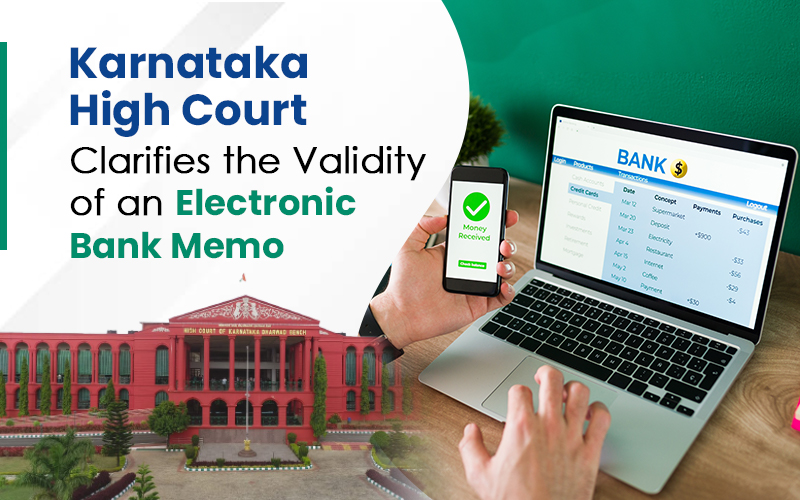
The Court was to consider whether a bank return memo which has been generated in an electronic manner without any seal or signature could be relied upon. It also examined whether the accused had been able to rebut the legal presumption that the cheque was issued for repayment of a debt.
The limited scope of interference in revision when both courts are of the same opinion was also looked into.
Facts of the Case
Both the parties were well-acquainted with each other for a really long time. In October 2014, the accused approached the complainant for some financial help and borrowed ₹3 lakhs. He promised to return it with interest within two months. When he didn’t keep his promise, the complainant followed up and the accused issued a post-dated cheque on 24 November 2014, for the same amount. When it was deposited, it was returned unpaid with the remark “ funds insufficient.”
The complainant then issued a legal notice which the accused did not comply with. This was followed up with filing of a complaint under Section 200 of the Code of Criminal Procedure.
The complainant produced the cheque and the bank return memo along with other documents during the trial. It was admitted by the accused that the cheque belonged to him and that it was his signature. He claimed that he issued the cheque as a blank security cheque to a society and was misused. The accused also claimed that the complainant did not have the financial capacity to lend such an amount and questioned the validity of the bank memo since it did not have any seal or signature upon it.
Both the trial court as well as the appellate court rejected these arguments and the accused was convicted.
Legal Issues
- Whether a bank memo which has been electronically generated is a valid proof of dishonour if it’s without a seal or a signature.
- Whether admitting a signature raises a presumption as to debt, which is legally enforceable under Section 139 of the NI Act.
- Whether the statutory presumption was properly rebutted by the accused.
- Whether the plea as to a security cheque’s misuse is sustainable without evidence.
Decision
The revision petition was dismissed by the High Court and the conviction was upheld.
It was held that when it comes to banking systems in today’s world, electronic records involving return memos, do not require any seal or signature to be valid. Since the memo was not challenged by the accused through bank evidence, it was considered as proper proof of dishonour.
The Court observed that once the cheque and signature are accepted, the law presumes that it was issued for a legally enforceable debt. The burden is on the accused to rebut the same. In the current scenario, the defence taken as to misuse was unsupported, as no evidence was produced to show that the cheque has been wrongly used. The argument as to financial capacity also didn’t seem legit, particularly when the earlier transactions were admitted by the accused himself.
Lastly, it was held that in revision, the court cannot reevaluate the evidence unless the findings are unreasonable on the face of it. Since both the lower courts had taken a reasonable approach, there was no ground for interference.
The conviction and sentence were accordingly confirmed.