IndiaMart Inter Mesh Limited Vs. OpenAI Inc. and Ors.
IP-COM/57/2025
(SJB, Before Ravi Krishan Kapur, J.)
Overview
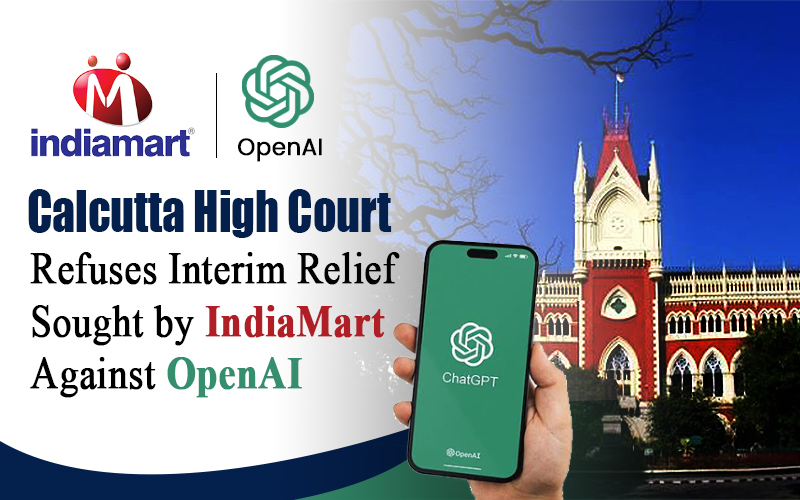
The Calcutta High Court recently dealt with a dispute involving IndiaMart Inter Mesh Limited and OpenAI Inc. The case arose out of an application seeking interim relief against the ChatGPT search feature of OpenAI.
It was alleged by IndiaMart that ChatGPT Search was intentionally excluding links to its platform while providing links to the other competing websites. This practice allegedly reduced the user traffic, and caused commercial harm which amounted to unfair business practices.
The Court had to determine whether a private AI platform could be compelled to provide visibility to another business and whether the omission of links could give rise to a claim which is legally enforceable.
Facts of the Case
IndiaMart, the petitioner herein, has been operating as a B2B online marketplace since 1996. Its dependency lies significantly upon the traffic generated through search engines and digital intermediaries. The company owns several trademarks and it also serves a large user base across India.
The petitioner filed a commercial intellectual property action against OpenAI, the respondent herein and its ChatGPT search feature. The respondent introduced ChatGPT Search in October 2024. It was claimed that when users searched for products available on its platform, ChatGPT often bypassed IndiaMart and instead provided links to the sellers directly. However, in the case of certain competing platforms, direct platform-specific links were allegedly provided by ChatGPT. Aggrieved by this alleged exclusion, the petitioner approached the Calcutta High Court seeking interim relief.
It was argued by the respondent that the ChatGPT Search feature uses a large language model to generate the responses and incorporates certain safeguards referred to as guard rails. It was also stated that the exclusion of the petitioner was due to the internal policies influenced by concerns as to the United States Trade Representative’s Review of Notorious Markets List 2024.
This explanation was challenged by the petitioner by arguing that the USTR report was not legally enforceable in India. It was also pointed out that other platforms received proper visibility through ChatGPT, even though they appear on the same list.
Legal Issues
- Whether there exists an obligation imposed by law upon a private platform to provide visibility to a third-party business.
- Whether ChatGPT is covered under the scope of intermediary or an originator under the Information Technology Act, 2000.
- Whether a business has a legally enforceable right to appear on a private platform.
- Whether the policies of OpenAI as to the appearance of the links can be legally challenged.
Decision
The application for interim relief was dismissed by the Calcutta High Court. It was observed that the petitioner failed to prove that there existed a legal right requiring OpenAI to provide visibility upon its platform.
The Court held that no private business can be compelled by another private business to promote its services in a particular manner.
It was found that the petitioner had not made out a prima facie case of copyright or trademark infringement, trade libel, or disparagement. Mere omission of a link could not by itself create such causes of action.
On the issue of the IT Act, it was stated that a fuller examination is required when it comes to the legal status of ChatGPT. However, it was observed that the nature of ChatGPT was closer to that of an “originator” rather than a passive intermediary.
While ruling that the petitioner failed to prove any legally enforceable right, the Court refused to grant any interim relief to the petitioner, and the parties were directed to proceed with the suit.