Revanasiddappa & Anr. (Appellants) Vs. Mallikarjun & Ors. (Respondents)
Civil Appeal No 2844 of 2011
(3JB, DY Chandrachud, J B Pardiwala and Manoj Misra JJ., delivered by DY Chandrachud CJI.)
Facts: The present reference arises before this three judge Bench of the supreme court wherein the correctness of the decisions in Jinia Keotin v Kumar Sitaram Manjhi, Neelamma v Sarojamma, and Bharatha Matha v R Vijaya Renganathan has been doubted by a two judge Bench in Revanasiddappa v Mallikarjun and referred to the present larger bench on the basis of the following premises:
- Section 16(3) does not qualify the expression ‘property’ either with ‘ancestral or self-acquired’ property. It sets out an express mandate that such children are only entitled to the property of their parents and not of any other relations
- Once children born from a void marriage (or a voidable marriage which has been declared to be nullity) are declared to be legitimate by subsections (1) and (2) of Section 16, they cannot be discriminated against and will be on par with other legitimate children for the purpose of all the rights in the property of their parents, both self-acquired and ancestral
- Section 16 was amended by Act 68 of 1976. As a consequence of the amendment, the common law view that children of a marriage which is void or voidable ‘are illegitimate’ ‘ipso jure’ has to change completely. The law has a socially beneficial purpose of removing the stigma of illegitimacy faced by children of such marriages, since the children themselves are innocent
- The benefit of Section 16 (3) is available only when there is a marriage but the marriage is either void or voidable in view of the provisions of the legislation
- In the case of joint family property, children born from a void or voidable marriage will only be entitled to a share in their parents’ property but not in their own right
- While the relationship between the parents may not be sanctioned by law, the birth of a child in such a relationship has to be viewed independently of such relationship. The interpretation of Section 16(3) must be based on the constitutional values of equality of status and opportunity as well as individual dignity
- A child born in such a relationship is innocent and is entitled to all the rights which are given to other children born in a valid marriage subject to the limitation that the right is confined to the property of the parents
- Section 16(3) as amended does not impose any restriction on the property rights of the children born of a void or voidable marriage except limiting it to the property of their parents. Hence, such children will have a right to whatever becomes the property of their parents, whether selfacquired or ancestral.
Issues: Whether a child who is conferred with legislative legitimacy under Section 16(1) or 16(2) is, by reason of Section 16(3), entitled to the ancestral/coparcenary property of the parents or is the child merely entitled to the self-earned/separate property of the parents?
Arguments on behalf of counsel for appellants:
With respect to the interpretation of Section 16(3) and the legislative intent behind the conferment of legitimacy, it is submitted that the property of the parent includes the share in the coparcenary property – once the larger coparcenary (including the father and his father, brothers, etc. is partitioned, the property must then be divided between the father and all his children, including those covered by Section 16. Further, the provision confers all the connotations of legitimacy on the children – including coparcenary rights in the property of the father. Children cloaked with legitimacy under Section 16(3) of the HSA 1956 are to be considered legitimate for the purpose of partition within the branch of the father. They cannot claim partition in the larger coparcenary, but once the larger coparcenary is partitioned- notionally or actually, and the property comes in the hands of the father, all his children – legitimate per se or legitimate by reason of S.16(3), have the same right in partition of this property in the hands of the father. The purpose of the Amendment is not just to eliminate the stigma experienced by the children of void or voidable marriages, but to treat all legitimate children alike. Section 16(3) does not qualify the word “property” with ancestral/coparcenary or separate/self-acquired. Therefore, inserting such a qualification to exclude the coparcenary property of the parent would be legislation by the court. The legislative intent of Act 68 of 1976 is to treat all legitimate children equally, as coparceners. Limited reading of S.16(3) violates the property rights of the children born out of void or voidable marriages under Article 300A of the Constitution of India.
Arguments on behalf of counsel for respondents:
It is submitted that the property in the hands of the father after the partition from the larger coparcenary, is still coparcenary property belonging to the father as well as the children (who are per se considered legitimate); as such, it is not the ‘property of the parent’ as per Section 16(3), HMA and thus, the children under Section 16(3), have no right in it. Further, the intention of the legislature was merely to erase the stigma, and not to interfere with the structure of a coparcenary which does not include the children covered by Section 16; and thus, under Section 16(3), the only right is with respect to the self-acquired/ self-earned property of the parent. Further, there is a difference between conferring legitimacy on a child and elevating them to the status of a coparcener. While Section 16 of the HMA 1955 grants legitimacy, Section 16(3) clarifies the extent of inheritance rights. Article 14 of the Constitution of India allows reasonable classification with an intelligible differentia, which justifies treating children from various marriages differently due to distinct legal status. The legislative intent behind Section 16 is to bestow legitimacy and inheritance rights upon children from void and voidable marriages. However, these rights are intentionally confined to parental property, excluding coparcenary or ancestral property. Parliament has ensured that these children possess inheritance rights within the scope of their parents’ property. This process has converted inherited property into the parents’ self-acquired property, thereby enabling legitimate children to utilize the benefits outlined in Section 16 of the HMA.
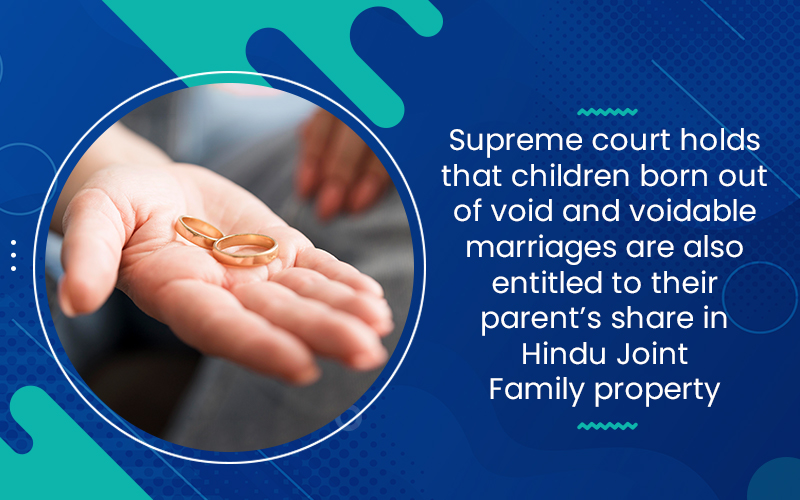
Held: The court held that, “While conferring legitimacy in terms of sub-section (1) on a child born from a void marriage and under sub-section (2) to a child born from a voidable marriage which has been annulled, the legislature has stipulated in subsection (3) of Section 16 that such a child will have rights to or in the property of the parents and not in the property of any other person.”
Further, it was concluded that, “once the share of the deceased Hindu Mitakshara coparcener in property that would have been allotted to him if a partition had taken place immediately before his death is ascertained, his heirs including the children who have been conferred with legitimacy under Section 16 of the HMA 1955, will be entitled to their share in the property which would have been allotted to the deceased upon the notional partition, if it had taken place, and the provisions of the Hindu succession Act 1956 have to be harmonized with the mandate in Section 16(3) of the Hindu Marriage Act 1955 which indicates that a child who is conferred with legitimacy under sub-sections (1) and (2) will not be entitled to rights in or to the property of any person other than the parents. The property of the parent, where the parent had an interest in the property of a Joint Hindu family governed under the Mitakshara law has to be ascertained in terms of the Explanation to sub-section (3) of section 16 of the HMA.”
The court clarified that the present reference to the three Judge Bench in this batch of cases is confined to Joint Hindu families governed by Mitakshara law, and directed the registrar (Judicial) to immediately circulate a copy of the Judgment to the Registrars (Judicial) of all the High Courts who shall upon taking suitable directions from the Chief Justices on the administrative side ensure that all pending cases involving the issues decided here are listed for hearing and disposal before the assigned benches according to the rosters of work.