Bejla Oraon [Appellant(s)] Vs. Kali Das Oraon and Ors. [Respondent(s)]
CIVIL APPEAL NO. 8780 OF 2026
(Arising out of SLP (C.) No. 23458 of 2024)
(DB, Sanjay Karol and Nongmeikapam Kotiswar Singh, JJ., Delivered by Sanjay Karol, J.)
Overview
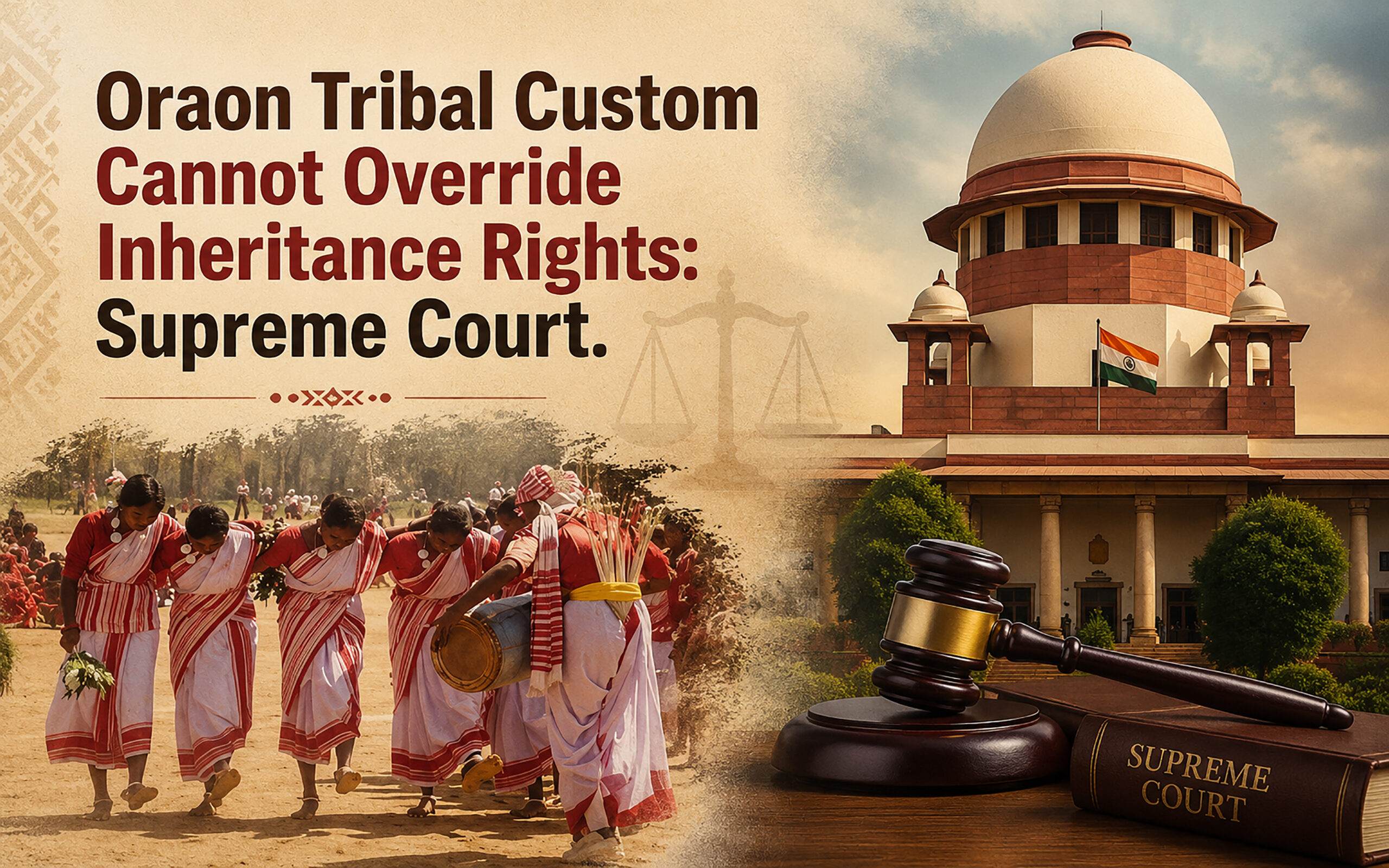
In this matter, the Supreme Court basically analysed whether a person could claim inheritance over ancestral property by relying on the Oraon tribal custom of ghardamad (resident son-in-law) without proving that the custom had been properly followed. The appeal challenged concurrent judgments of the Trial Court, the First Appellate Court and the High Court of Jharkhand, all of which dismissed the claim of the plaintiff over the property in question.
The dispute revolved around ancestral land belonging to the members of the Oraon tribe, and the claims of the nearest male agnate and the husband of her daughter who claimed rights as ghardamad.
The principal issue to be dealt with by the Court was whether an uncle-in-law could confer the status of ghardamad under the tribal customs to nullify the inheritance rights of the nearest male heir.
Facts of the Case
The dispute arose from ancestral property owned by Sukhu Oraon, who had three sons, Dhungru, Ledura, and Bhoula. The original plaintiff was the son of Dhungru and claimed ownership over the entire property after the other branches of the family collapsed.
The defendants were Budhain, the daughter of Bhoula, and her husband Punai Oraon. They argued that since Ledura had no children, he had accepted Punai as his ghardamad, thereby granting him rights to inherit Ledura’s share of the property. They also relied upon a partition deed which was executed between Budhain and Ledura in February 1975 to support their claim.
The plaintiff contended that neither Budhain nor Punai possessed any right over the property under the customary law governing the Oraon Community. It was also clear that, according to the tribal custom, daughters did not inherit ancestral property. The Trial Court, the First Appellate Court, and the High Court accepted the case of the defendants and upheld the ghardamad arrangement.
Aggrieved by these findings, the appellant approached the Supreme Court.
Legal Issues
- Whether the alleged ghardamad custom has been validly established in accordance with the law.
- Whether an uncle-in-law could confer the status of ghardamad under the customary law of the Oraon tribe.
- Whether the nearest male agnate was entitled to inherit the property when a validly recognised ghardamad was absent.
- Whether the title could be conferred by the partition deed upon the people who possessed no inheritable rights under the customary laws.
Decision
The Supreme Court allowed the appeal and the judgments of the courts below were set aside.
The Court observed that a custom cannot be accepted only because there is no evidence which prohibits it. A party relying upon a customary law must establish that it is certain, continuous, ancient, and recognised by the community.
Examining the material on record, no evidence was found by the Court which showed that an uncle-in-law could induct his niece’s husband as a ghardamad under the customary law of the Oraon tribe.
While referring to the writings on Oraon customs, the Court noted that the status of ghardamad could be conferred by the last male owner or, in appropriate circumstances, by his widow. Since Punai was the son-in-law of Bhoula and not of Ledura, the essential requirements of the custom had not been established.
The Court further held that in absence of a validly recognised ghardamad, the property would devolve upon the nearest male agnate in accordance with the established customary law of the Oraon community. It also clarified that the partition deed which was relied upon by the defendant could not create any title because Budhain herself had no inheritable share in the property. Therefore, the appendant’s claim over the ancestral property was upheld and the suit remained decreed.