Introduction
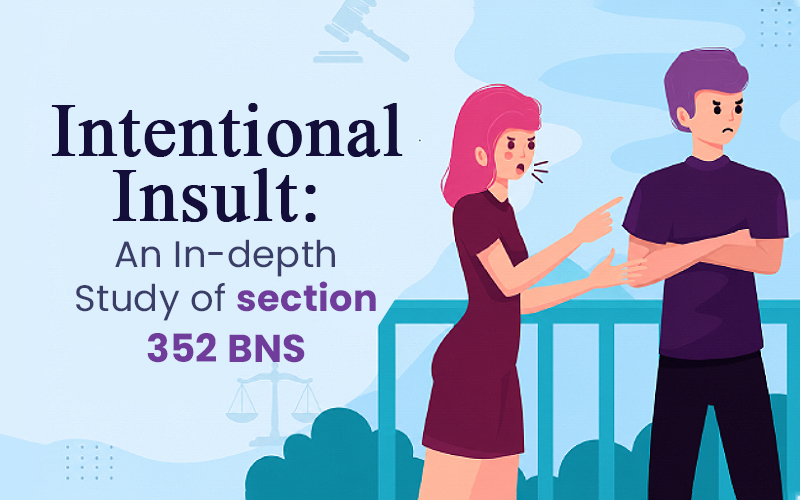
Arguments as well as offensive remarks are an unfortunate part of everyday life. However, there are certain situations where words are used not only to express anger or disagreement, but to deliberately provoke a person into reacting violently. Section 352 of the Bharatiya Nyaya Sanhita, 2023 (BNS) seeks to address this type of conduct.
Section 352 came into force with the implementation of the BNS on 1 July 2024. It replaces Section 504 of the Indian Penal Code. Although the actual substance of law remains the same, the provision continues to serve an important purpose, i.e., preventing any verbal provocation from escalating into a public disorder.
It is important to understand the scope of this provision because many people believe that every offensive statement amounts to a criminal offence. The law draws proper distinction between ordinarily being rude and doing something that is a genuine threat to public order.
When Does an Insult Amount to a Criminal Offence?
Not every unpleasant comment amount to criminal liability under Section 352. Certain essential elements should be present before an offence can be said to have occurred.
Firstly, there must be an intentional insult. The words or conduct should be deliberate and directed towards offending another person. A misunderstanding or merely an accidental statement does not satisfy this requirement.
Secondly, the insult must be capable enough of provoking the other person against whom it is directed. The accused must either intend or know that such provocation would result in a breach of peace or lead the other person to commit an offence.
Indian courts have repeatedly emphasised upon this distinction. In Pukhraj vs. State of Rajasthan, it was observed that merely using offensive language or bad manners does not constitute an offence. Likewise, in the case of Ramji Lal Modi vs. State of Uttar Pradesh, it was clarified by the Supreme Court that the provision is concerned with situations where the conduct is likely to disturb public peace.
More recently, the courts have continued to adopt a very cautious approach. In Nalla Ballu vs. State of Telangana, it was reiterated that even strong criticism or harsh language cannot be considered as an offence unless there is a proper connection between the conduct and the likelihood of public disorder.
Punishment and Criminal Liability Under Section 352
Section 352 provides for a maximum of two years imprisonment. The court may impose simple imprisonment, rigorous imprisonment, a fine, or both, depending upon the facts and circumstances of the case.
The punishment is not solely determined by the used words. Courts generally consider the overall circumstances, including the relationship between the parties, the intention of the accused, the overall circumstances, the seriousness of the provocation and the consequences that followed.
For example, an isolated argument between neighbours may be viewed differently from a deliberate attempt to provoke violence against a public servant or a member of the community. Therefore, the law allows the Magistrates to assess each case properly and then impose a punishment which is proportionate to the conduct involved.
The objective is not to punish people only for being rude, rather it is to discourage the conduct that creates a possibility of violence or disturbance of public peace.
Section 352: Bailable or Non-Bailable?
Section 352 of BNS is a bailable offence. This means that an accused person can seek release on bail as a matter of right upon fulfilling certain legal requirements. Unlike more serious offences, where bail depends largely upon the discretion of the judiciary, the law provides a more liberal approach in cases which fall under this provision.
Another relevant feature is that the offence is non-cognizable. This means that the police cannot arrest a person without a warrant issued by the magistrate. A complaint must be presented before the court, which then decides whether the proceedings should be initiated or not.
These safeguards reflect the less serious nature of the offence while still ensuring accountability when deliberate or intentional provocation threatens public order. The offence is also compoundable, which allows the parties to settle the disputes and bring the proceedings to an end. This is often beneficial in family disputes and workplace disagreements where maintaining future relations is of utmost importance.
Conclusion
In today’s digital world, disagreements often occur through social media posts, messages and online platforms. However, not every offensive remark amounts to an offence under Section 352 of the BNS. Courts continue to examine the intention behind the communication and whether it was likely to provoke a breach of public order.
In G Sivaraja Boopathi vs. State, emphasis was laid upon the importance of assessing the context of the communication. Wherever reliance was placed upon the electronic evidence, such as a screenshot or a message, it must satisfy the requirements of the Bharatiya Sakshya Adhiniyam.
Ultimately, the main aim of Section 352 is to prevent deliberate provocation that threatens public peace. It does not criminalise every insult or disagreement, but it seeks to ensure that personal conflicts do not escalate into situations which disturbs social harmony.