Introduction
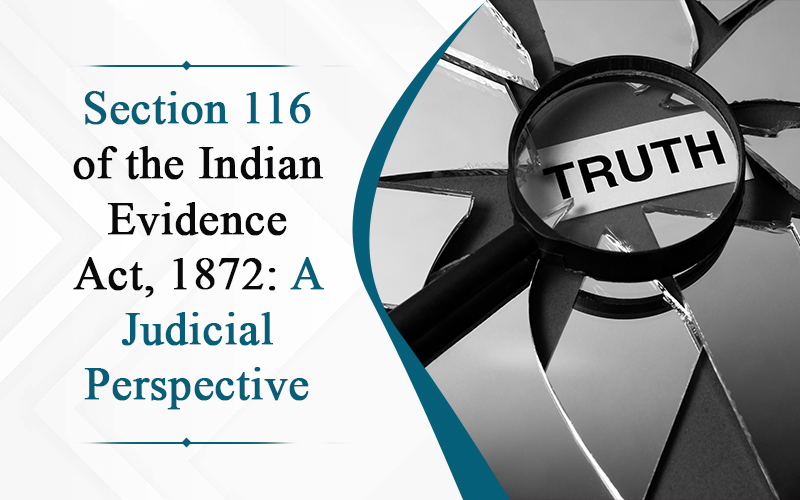
Section 116 of the Indian Evidence Act, 1872 is based on a very simple idea i.e., if the possession of a property is given to someone, that person cannot later question their right to give it, at least while still enjoying that possession. This rule is usually applicable to relationships such as that of landlord and tenant or licensor and licensee.
The Indian courts, when it comes to tenancy disputes, have dealt with this provision time after time. Through various judgments, they have clarified situations where this rule should be applied in a strict sense and where it should be applied in a relaxed manner.
The purpose of the same has always been to prevent unfair conduct while resolving the cases in a just and reasonable manner.
Scope of Section 116 of the Evidence Act
Section 116 creates a restriction on tenants as well as licensees. Once they get hold of a property with somebody else’s permission, they cannot deny that person’s right over the property for the time they continue to stay there. This is applicable to both tenants as well as people claiming through them, such as sub-tenants. This usually operates only during the period of possession.
To properly understand the scope of Section 116, let’s look at the case of Bansraj Laltaprasad Mishra v. Stanley Parker Jones. In this case, the Supreme Court held that what’s important is not whether the landlord had a perfect title, but the fact that the licensee was handed over the possession by them. The act itself creates a restriction.
Judicial Applicability of Section 116 in Real Cases
Courts have usually applied Section 116 in a strict manner. The reason behind the same is quite simple. Once a person accepts a certain benefit, they cannot deny the foundation of that benefit.
In the case of Anar Devi v. Nathu Ram, it was held that, if a tenant accepts someone as a landlord, through paying the rent or through any other acknowledgement, the title of that person cannot be denied later.
Similarly, in the case of Dangam Venkata Rajam v. Peddi Gundla Rajiah, it was held that if a person already had the possession of the properly and even if the tenancy agreement is signed later, the rule is still binding.
In P.C. Kaul v. Krishna Wati, the court came before a situation whereby a tenant accepted a new landlord. It was held that once the tenant continues to reside and have possession under the new owner, the tenant cannot later question the title of that person.
All these judgments basically show that courts usually do not allow tenants to take an inconsistent position. A person cannot acknowledge a relationship whenever it’s convenient and then deny it when it’s not.
Exceptions and Limitations to Section 116
Even though the rule is rigid and strict, the courts have considered the fact that it cannot be applied blindly in every situation.
An important limitation is that the rule is applicable only when the tenant is in possession. When the tenant returns the property back to the owner, they are free to challenge the title through a separate process.
Another exception is when a third party claims the better title and steps in. In such a scenario, if the tenant is evicted by such a person or is forced to accept their title, the restrictions mentioned earlier are not applicable.
In the case of Rajeshwar Prasad vs. Sita Ram Marwari, the court clarified that if a landlord’s title has been declared invalid by a court, then the tenant can rely on that particular finding.
Courts have also addressed situations where the tenancy itself was created through fraud or any sort of misrepresentation. In such scenarios, the tenant has the immunity to challenge it.
These exceptions show that Section 116 cannot be relied upon in unfair or dishonest circumstances.
Conclusion and Way Forward
Section 16 is usually used in a very practical manner. It assists the courts to avoid any arguments which are not required as to the ownership when the issue at hand is very simple, i.e., whether the tenant should continue to be in possession of a property or not. Once a tenant accepts someone as landlord, they cannot challenge it later.
Courts also pay attention to the earlier actions of the tenant. They look at both words as well as actions. Once a tenant’s conduct clearly shows acceptance of a landlord, it becomes very difficult to take a different stand later.
At the same time, the courts have also made sure that this rule should not lead to any unfairness towards the tenant. If there is a genuine reason, such as loss of possession or a stronger title coming in, courts do consider the reasonings of the tenant.