Introduction
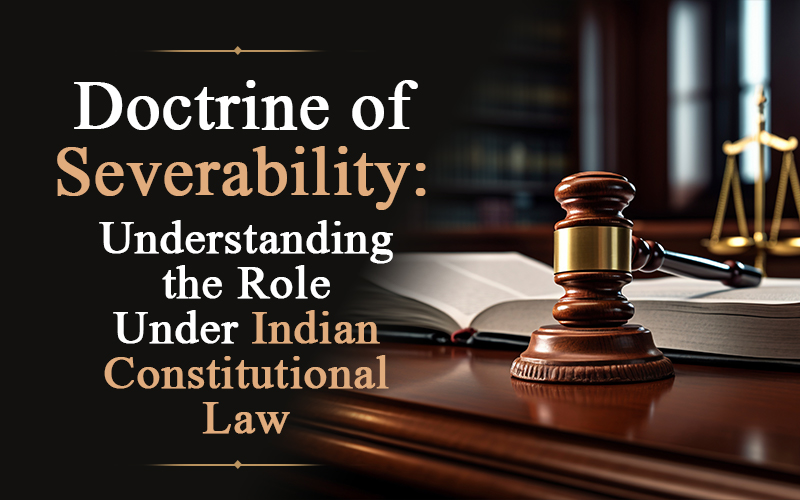
The Doctrine of Severability is an important principle under the constitutional law, which helps the courts to create a balance between protection of the fundamental rights and preserving the intent of the legislation. Instead of invalidating the entire law, because only a part of it is unconstitutional, the courts remove only the defective part and allow the rest to continue being in effect. This ensures that valid laws are not unnecessarily hindered while still upholding the Constitution.
The principle portrays a practical approach, correcting what’s wrong without disturbing what continues to serve its purpose.
Evolution and Legal Basis of the Doctrine
In India, the legal basis of the Doctrine of Severability lies in Article 13 of the Constitution of India, which makes it clear that laws which are inconsistent with the fundamental rights are only void “to the extent of” such inconsistency. The intent and purpose of the doctrine revolve around this phrase and limits the invalidity to the portion which is problematic.
Articles 251 and 254 follow a similar logic when it comes to the cases of disputes between the Central and the State laws. The principle itself developed from the English and American legal systems, where the courts began to separate the constitutional and the unconstitutional parts of a law. The Indian courts later adopted this principle into the interpretation of the Constitution and the concept of judicial review.
Application by the Judiciary in the Key Judgements
The Indian courts have applied the Doctrine of Severability in several important cases. In the case of A.K. Gopalan v. State of Madras, only a specific provision of the Preventive Detention Act was invalidated, while the rest of the legislation continued to remain in force. In the case of Minerva Mills v. Union of India, certain parts of the 42nd Amendment were invalidated, but the amendment itself was not completely rejected. Similarly, in the case of Kihoto Hollohan v. Zachilhu, only part of the Tenth Schedule was removed.
In a few cases, the doctor has also been used to increase the benefits coming out of a law. In D.S. Nakara v. Union of India, the court removed a restriction as to an arbitrary date, making the benefits of pension available to a larger group of individuals. A more recent example is the case of Navtej Singh Johar v. Union of India, whereby the court invalidated only those portions of Section 377, which criminalized consensual same-sex relations while retaining the rest of the provision.
Comparisons and Limitations
The Doctrine of Severability is not just limited to constitutional law. For example, in arbitration, an arbitration clause will be valid, even if the main agreement is invalid.
The doctrine also has certain limits. In the current legal system, the provisions are often connected with each other, which might make it difficult to separate them. Another concern is that the courts might go too far and reshape the entire law, which is ideally the role of the legislature.
Conclusion
The Doctrine of Severability creates a balance between the supremacy of the Constitution and the role of the legislature. By removing the unconstitutional parts of a law, the courts ensure that valid intent is preserved while the fundamental rights stay protected. It plays an essential role in maintaining both the legal stability as well as the integrity of the Indian Constitution.