Suhas Chakma (Petitioner ) Vs. Union of India and Ors. (Respondents)
W.P.(C) No. 1082 of 2020
(2JB, Sandeep Mehta and Vikram Nath, JJ.)
Overview
The case is related to a petition laid down before the Supreme Court, concerning the prisons which are overcrowded, along with the lack of facilities provided to the prisoners. It highlights how excessive population in a prison lead to poor living conditions for the prisoners, which eventually violate their dignity and basic fundamental rights.
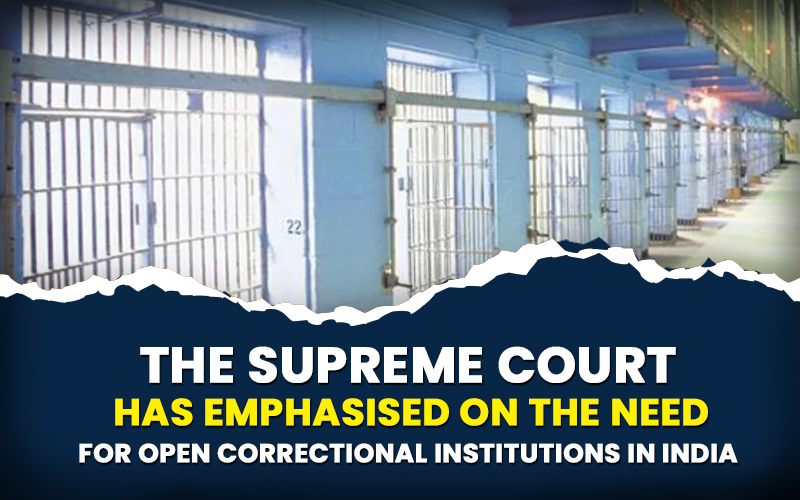
While examining the issue, the court majorly discussed the Open Correctional Institutions (OCIs). These institutions basically allow the prisoners who are eligible, to live in a less constraining environment with much less restrictions where they can maintain contact with their family, can work, and slowly re-enter into society.
Therefore, the court had to decide whether the current framework for such institutions in India was properly functioning, and if any additional steps were required to strengthen it more across the country.
Facts
The matter came before the Supreme Court as a writ petition, which was filed under Article 32 of the Indian Constitution, raising concerns about the overcrowded prisons in India. Suhas Chakma, the petitioner in the matter, argued that there were many prisons, which were operating outside their regulatory framework, which resulted in extremely difficult living conditions for the prisoners. It was also alleged that such conditions violate the fundamental rights of the prisoners, specifically their right to life and dignity under Article 21 of the Constitution.
The petition also discussed the need for a stronger mechanism to manage the population of the prison and ensure proper treatment of the prisoners. Some of the measures suggested were as to increased monitoring of prison occupancy, increasing the facilities which promote rehabilitation rather than confinement, better transfer facilities between prisons, etc.
The Apex Court, during the proceeding, examined the OCIs, and directed the States and the Union Territories to submit proper information as to the functioning and management of such institutions. The data which was placed before the Court revealed several problems, such as, under-utilisation of open prisons or their complete absence, rules making the eligibility criteria of the prisoners unnecessarily restrictive, lack of facilities to women prisoners, etc. The court also examined that in many of the States, prisoners had to spend around 4 to 12 years in closed prisons before they could even be considered for an open prison. The circumstances led the court to properly address the issue of reforms as to the prison framework.
Legal Issues
- Whether the failure of many states when it comes to proper use of OCIs shows neglect of responsibility towards regulatory framework of prisons.
- Whether over populating the prisons and exceeding the laws and regulations, violates the right to life and dignity of the prisoners under Article 21 of the Constitution.
- Whether the absence of facilities for women, when it comes to open prisons, a violation of Article 14 and 15 of the Constitution.
Decision
The Supreme Court made it very clear that reforms as to prison is not an option for the government, but rather a constitutional duty. The court stated that even people in prison have the right to life and dignity under Article 21 of the Constitution.
To improve and move forward with the current situation, the court gave certain directions to create a High Powered Committee led by Justice S. Ravindra Bhat (Retd.) to set some general standards for OCIs all across India. The States were asked to properly bring such facilities into use and ensure equal access of the same to women prisoners. The court at last directed the High Courts to properly monitor if these directions are being implemented by taking in regular reports, ensuring that the prison reforms are gradually moving forward towards a more humane system. The matter is next listed on 31 March 2026 for further evaluation as to the responses by the High Courts.