THE STATE OF JHARKHAND & ORS. [APPELLANTS] Vs. RUKMA KESH MISHRA [RESPONDENT]
CIVIL APPEAL ARISING OUT OF SLP (C) NO. 19223 OF 2024
(2JB, DIPANKAR DATTA and MANMOHAN JJ., delivered by DIPANKAR DATTA, J.)
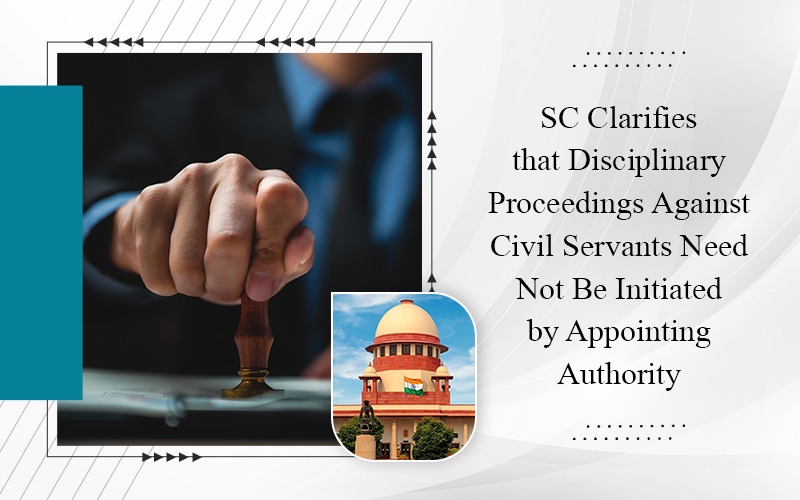
The Supreme Court has ruled that departmental proceedings against civil servants do not necessarily have to be initiated by the appointing authority. The verdict was issued while overturning a Jharkhand High Court order that had reinstated a civil servant who was previously dismissed for financial irregularities and document forgery, both of which constitute misconduct.
The case originated when a civil servant (Respondent) challenged his dismissal before the Jharkhand High Court. He argued that the charge-sheet issued in the disciplinary proceedings was not approved by the Chief Minister, making the entire process unlawful. A Single Bench of the High Court ruled in his favor, ordering his reinstatement along with all consequential benefits. The State then appealed this decision, but the Division Bench upheld the reinstatement, citing procedural irregularities in the approval of the charge-sheet.
Dissatisfied with the ruling, the State government escalated the matter to the Supreme Court, contending that the High Court’s decision was incorrect. The Supreme Court bench, comprising Justice Dipankar Datta and Justice Manmohan, allowed the appeal and reinstated the original dismissal of the civil servant.
The Supreme Court clarified that Article 311(1) of the Constitution does not require that disciplinary proceedings must be initiated only by the appointing authority. Instead, it provides that no civil servant can be dismissed or removed by an authority subordinate to the one that appointed them. However, the initiation of disciplinary proceedings is a separate matter, which can be conducted by an authority empowered by general or special orders of the government.
The Court referred to the case of Union of India v. Kunisetty Satyanarayana (2006), where it was held that a writ petition does not generally lie against a charge-sheet or a show-cause notice, as they do not constitute an adverse order affecting a party’s rights. The Court emphasized that High Courts should not interfere in disciplinary proceedings unless the charge-sheet is issued by someone who lacks jurisdiction or is wholly illegal.
Additionally, the Court cited P.V. Srinivasa Sastry v. Comptroller and Auditor General (1993), which reaffirmed that while Article 311(1) protects civil servants from being dismissed by a subordinate authority, it does not mandate that the departmental proceedings must be initiated only by the appointing authority. In the present case, the Supreme Court noted that Rule 16(1) of the 2016 Rules allows disciplinary proceedings to be initiated by any authority empowered by a general or special order of the government. Furthermore, even if Rule 17(3) were applicable, the Chief Minister had already approved the initiation of disciplinary proceedings, making the absence of a separate approval for the charge-sheet a non-issue.
By setting aside the High Court’s ruling, the Supreme Court reinforced the principle that disciplinary proceedings against civil servants need not be initiated solely by the appointing authority unless specific rules require otherwise. The decision upholds administrative efficiency and prevents procedural loopholes from being exploited to escape disciplinary action.