NEW MANGALORE PORT TRUST & ANR. [APPELLANTS] Vs. CLIFFORD D SOUZA ETC.ETC. [RESPONDENTS]
CIVIL APPEAL NOS. 1796-1828 OF 2024
(2JB, VIKRAM NATH and PRASANNA B. VARALE JJ., delivered by VIKRAM NATH, J.)
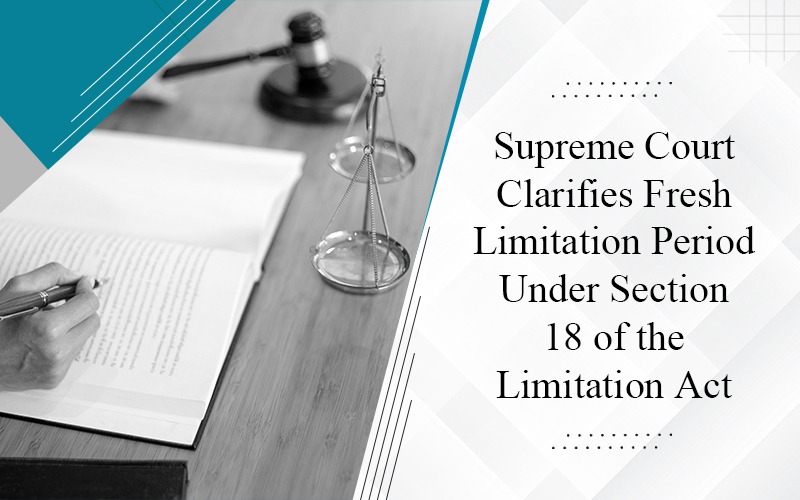
The Supreme Court of India has ruled that under Section 18 of the Limitation Act, 1963, where liability is acknowledged regarding any property or right, a fresh limitation period may be computed from the time the acknowledgment is signed. This decision came in response to Civil Appeals filed by the New Mangalore Port Trust (NMPT) challenging the Karnataka High Court’s judgment, which had dismissed NMPT’s Writ Petitions against a District Judge’s ruling.
NMPT had allotted land to certain Licensees for loading and unloading goods, subject to the payment of a license fee, which was to be revised every five years with approval from the Tariff Authority for Major Ports (TAMP). The initial allotment took place in 2003, followed by a revision of the license fee. Consequently, in March 2011, the Assistant Estate Manager issued demand notices to all Licensees for the payment of arrears.
The Licensees contested the demand, arguing that retrospective revision of the license fee was impermissible. They filed Writ Petitions before the Karnataka High Court, which were dismissed by a Single Judge. Subsequently, they approached the Division Bench through Writ Appeals, which remained pending without any interim relief. In the meantime, fresh demand notices were issued, prompting the Licensees to object.
Following this, NMPT initiated proceedings under the Public Premises (Eviction of Unauthorised Occupants) Act, 1971 (PP Act). The Estate Officer issued notices under Section 7(3) of the Act, requiring the Licensees to show cause as to why they should not be directed to pay the outstanding dues with interest. The Licensees challenged this through a Miscellaneous Appeal under Section 9 of the PP Act before the District Judge, who ruled that the proceedings under Section 7(1) were barred by limitation and subsequently set aside the demand. Aggrieved by this decision, NMPT approached the Karnataka High Court via Writ Petitions, but the court dismissed them, leading NMPT to appeal to the Supreme Court.
The Supreme Court observed that the Licensees had consistently argued that the time for payment had not yet arrived due to the pending appeals before the Division Bench. This acknowledgment, made in response to NMPT’s demand within the limitation period, entitled NMPT to an extension of the limitation period under Section 18 of the Limitation Act.
Furthermore, the Court pointed out that once the Single Judge had upheld the retrospective tariff revision and dismissed the Writ Petitions, the High Court should have awaited the outcome of the pending intra-court appeals before proceeding with NMPT’s Writ Petitions. The Licensees’ continued resistance to payment, despite being aware of their defeat at the Single Judge level, was seen as an attempt to delay their obligations.
The Supreme Court set aside the Karnataka High Court’s order and restored NMPT’s Writ Petitions. It ruled that the Writ Petitions should be decided after the resolution of the pending intra-court appeals. If the appeals succeed, the demand for retrospective recovery would be withdrawn. However, if the appeals fail, the Licensees would be liable to pay the dues with interest. This ruling reinforces the principle that acknowledgment of liability extends the limitation period, providing clarity on legal obligations in similar cases.