THE SECRETARY, ALL INDIA SHRI SHIVAJI MEMORIAL SOCIETY (AISSMS) AND ORS. [APPELLANT(S)] Vs. THE STATE OF MAHARASHTRA AND ORS. [RESPONDENT(S)]
CIVIL APPEAL [@ SPECIAL LEAVE PETITION (CIVIL) NO(S). 7058-7061 OF 2019]
(2JB, SUDHANSHU DHULIA and K. VINOD CHANDRAN, delivered by SUDHANSHU DHULIA, J.)
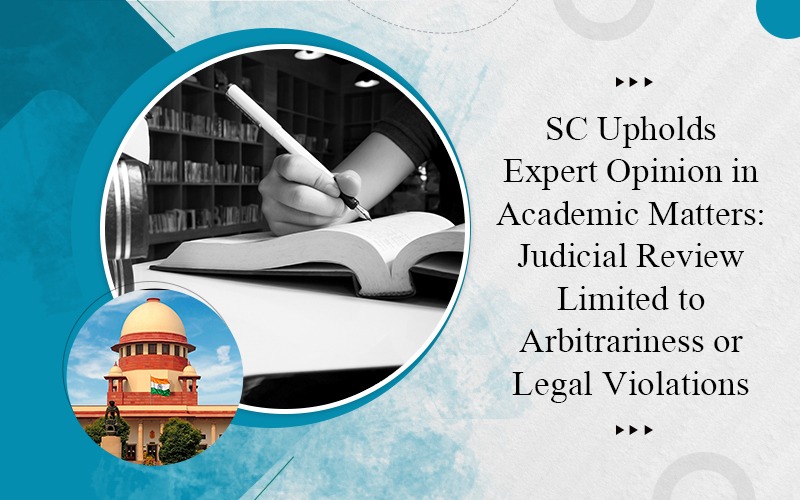
The Supreme Court, in a recent judgment, emphasized that courts must be cautious in interfering with expert opinions regarding academic standards. Judicial review should only be exercised when prescribed qualifications or conditions are arbitrary, unlawful, or involve the interpretation of a legal principle. The ruling came in response to Civil Appeals challenging a Bombay High Court order directing a private educational society to extend revised pay scale benefits to engineering institute teachers.
The case revolved around Assistant Professors appointed before March 15, 2000, when a Ph.D. was not mandatory for the role. The appellant, a private society managing technical institutes, contested the High Court’s directive, arguing that it was not under government aid and that only those with Ph.D. qualifications should receive higher pay scales under the 6th Central Pay Commission.
The Supreme Court, through a bench comprising Justices Sudhanshu Dhulia and K. Vinod Chandran, reaffirmed that courts should not usually interfere in decisions taken by expert statutory bodies on academic matters, such as student admission criteria, teacher qualifications, and pay structures. However, the judiciary retains the power of review in cases where qualifications are arbitrary or legally questionable.
The factual background revealed that the respondent-teachers, all possessing a Master’s degree, were appointed between 1995 and 2009. The AICTE first mandated a Ph.D. as a qualification for Assistant Professors on March 15, 2000. Of the nine private respondents, four were appointed before this date, and five after. A 2010 AICTE notification revised the pay structure and changed lecturers’ designation to Assistant Professors. The respondents sought benefits from this notification, particularly a higher pay scale and designation as Associate Professors, but were denied due to their lack of a Ph.D.
The Supreme Court upheld the High Court’s ruling regarding teachers appointed before March 15, 2000, confirming their entitlement to the revised pay scale. However, it categorized those appointed after this date differently, noting that they had failed to meet the mandatory Ph.D. requirement within seven years of appointment. The court ruled that such teachers could not receive the benefits of the 2010 AICTE notification.
The judgment clarified that only “incumbent Assistant Professors” — those holding a Ph.D. at the time of appointment, those who obtained a Ph.D. within seven years, or those appointed before March 15, 2000, when a Ph.D. was not required — were eligible for pay scale revisions. Those who failed to acquire a Ph.D. post-2000 were deemed ineligible for higher pay or promotion. The Supreme Court ordered the appellant to release the revised pay scales with 7.5% annual interest for teachers appointed before March 15, 2000.
However, those who failed to obtain a Ph.D. within seven years were denied re-designation as Associate Professors. The court allowed them to reapply for benefits upon acquiring a Ph.D., subject to institutional and AICTE approval. This judgment reinforces the principle that courts should respect academic regulatory bodies’ decisions unless they are arbitrary or unlawful.