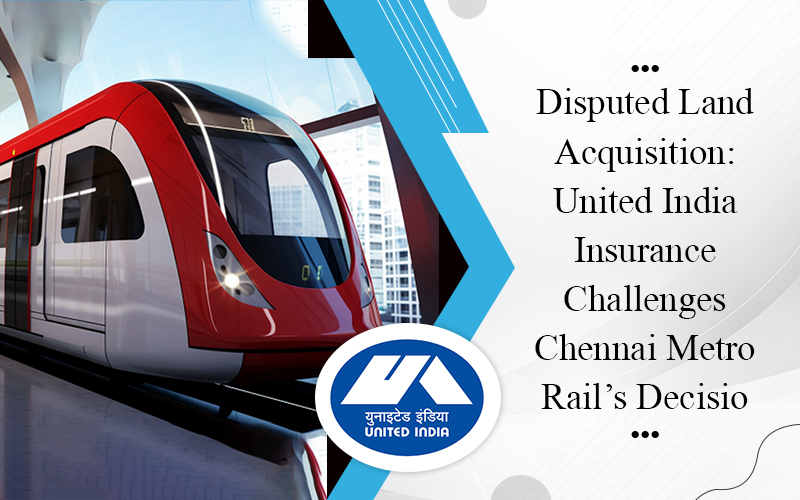
United India Insurance Company Ltd., Chennai-14 [Petitioner] Vs. The State of Tamil Nadu, rep. by the Secretary to Government [Respondents]
Writ Petition No.33116 of 2024
(The Honourable Mr. Justice N.ANAND VENKATESH)
The petitioner, United India Insurance Company Limited, filed a writ petition under Article 226 of the Indian Constitution challenging a notice dated 26.09.2024 issued by Chennai Metro Rail Limited (CMRL) under Section 3(2) of the Tamil Nadu Acquisition of Land for Industrial Purposes Act, 1997. The notice calls upon the petitioner to justify why its property, measuring 837 sq. meters, should not be acquired for Metro Rail Phase II.
The petitioner constructed an iconic 14-floor headquarters, certified as a three-star green building, after securing necessary approvals, including a No Objection Certificate (NOC) from CMRL. Initially, CMRL had planned the metro station’s entry/exit within a temple premises, but a Public Interest Litigation (PIL) led to an alternative proposal shifting the access point to the petitioner’s land. The PIL was disposed of based on CMRL’s undertaking to use the petitioner’s property, without the petitioner being heard.
CMRL argued that the change was made considering public sentiment, but the petitioner contends that the notice is a mere formality, as the decision to acquire the land was already made. The petitioner further asserts that its NOC from CMRL created a legitimate expectation that future projects would not affect its land.
The court considered the petitioner’s claim that the PIL order does not bind it, as it was not a party to the case. The case raises concerns over procedural fairness and the impact of land acquisition on private property rights.
The Chennai Metro Rail Limited (CMRL) had earlier declared that certain lands were not required for its project. Based on this, the Chennai Metropolitan Development Authority (CMDA) granted approval, leading the petitioner to invest substantial funds in construction. However, CMRL later reversed its stance through proceedings where the petitioner was not a party, violating Article 14 of the Constitution. The principle of promissory estoppel applies here, as per Supreme Court rulings in Motilal Padampat Sagar Mills Co. Ltd. and Manuelsons Hotels (P) Ltd., which affirm that a party can claim legal protection if they altered their position based on government representations.
The State’s argument that estoppel cannot be applied to sovereign functions, including land acquisition, was rejected in earlier cases. Courts have held that the government is equally bound by legal obligations as private individuals. The petitioner, having relied on official approvals, should not suffer due to arbitrary changes. Furthermore, the site shift appears to have been influenced by a Public Interest Litigation (PIL) rather than technical assessments. The court also examined whether religious institutions’ lands enjoy special protection from acquisition. The Supreme Court, in cases like Khajamian Wakf Estates and Acharya Maharajshri Narendra Prasadji, ruled that religious institutions can own property but are not exempt from acquisition if done lawfully.
The Allahabad High Court upheld a similar view, stating that land acquisition does not infringe upon religious institutions’ functioning. Thus, the petitioner’s rights were unfairly disregarded, warranting judicial intervention.