THE AUROVILLE FOUNDATION [APPELLANT] Vs. NAVROZ KERSASP MODY & ORS. [RESPONDENT(S)]
CIVIL APPEAL NO(s). 5781-5782 OF 2022
(2JB, BELA M. TRIVEDI and PRASANNA B. VARALE JJ., delivered by BELA M. TRIVEDI, J.)
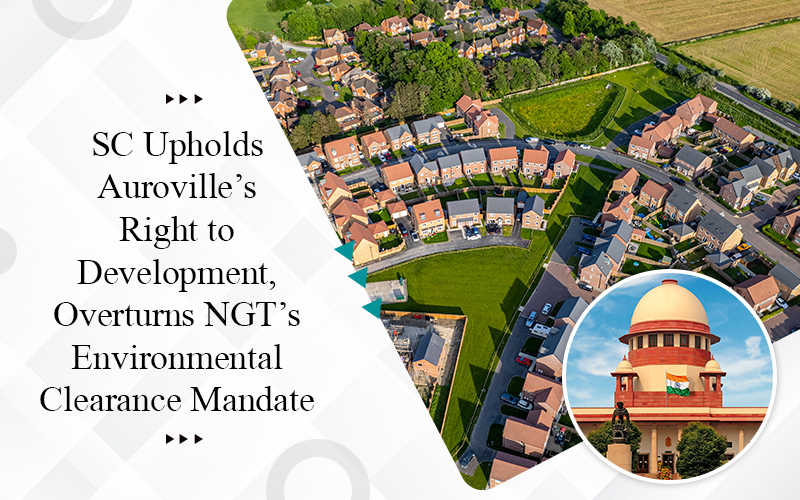
The Supreme Court of India has overturned a National Green Tribunal (NGT) order that restricted the Auroville Foundation from proceeding with development activities within its township in Puducherry. The ruling, delivered on March 17, 2025, by a bench comprising Justice Bela M Trivedi and Justice Prasanna B Varale, allowed the Foundation’s appeal against the NGT Southern Zone Bench’s April 2022 directive. The Tribunal had halted all developmental activities until the Foundation secured Environmental Clearance (EC).
Justice Trivedi, reading the judgment, emphasized the constitutional balance between environmental protection and development. While acknowledging the importance of environmental principles such as the precautionary and polluter pays doctrines, she stressed that the right to clean environment (protected under Article 14) must coexist with the right to development, which also derives its strength from Articles 14, 19, and 21 of the Indian Constitution. The Court highlighted the need for sustainable development, advocating for a “golden balance” between environmental safeguarding and developmental progress.
The Supreme Court held that in this case, there was no proven violation of environmental laws by the Auroville Foundation. As a result, the NGT’s assumption of jurisdiction and the directions issued were found to be a “gross error” and “legally untenable.” The apex court concluded that the NGT acted beyond its legal mandate, and therefore, its directives were set aside.
The NGT order stemmed from a petition filed by Navroz Kersasp Mody, who contested the cutting of numerous trees by the Foundation, arguing that the area in question constituted forest land and that the developmental project was leading to deforestation, particularly in the Darkali Forest. The petitioner sought to restrain the Foundation from clearing undergrowth or cutting trees, especially for the proposed “crown road” project.
In contrast, the Auroville Foundation countered that Auroville is an international cultural township and not a designated forest area, as claimed by the applicant. They maintained that their developmental activities aligned with the township’s original vision and did not breach environmental regulations.
The NGT had earlier directed the Foundation to draft a comprehensive township plan, detailing its future infrastructure, including ring roads, types of industries, and other proposed activities, alongside a phased execution plan. The Tribunal also instructed the Foundation to secure Environmental Clearance as per Item 8(b) of the EIA Notification, 2006, which governs townships and area development projects. Until such clearance was granted, the NGT had barred the Foundation from undertaking further construction.
The Supreme Court’s verdict now allows the Auroville Foundation to proceed with its developmental projects without the immediate requirement of an Environmental Clearance, restoring momentum to Auroville’s plans for expansion while underscoring the principle of sustainable development that respects both ecological and developmental imperatives.