ANMOL [APPELLANT(s)] Vs. UNION OF INDIA & ORS. [RESPONDENT(s)]
CIVIL APPEAL NO. 14333 OF 2024
(2JB, B.R. GAVAI and K. V. VISWANATHAN JJ., delivered by K.V. Viswanathan, J.)
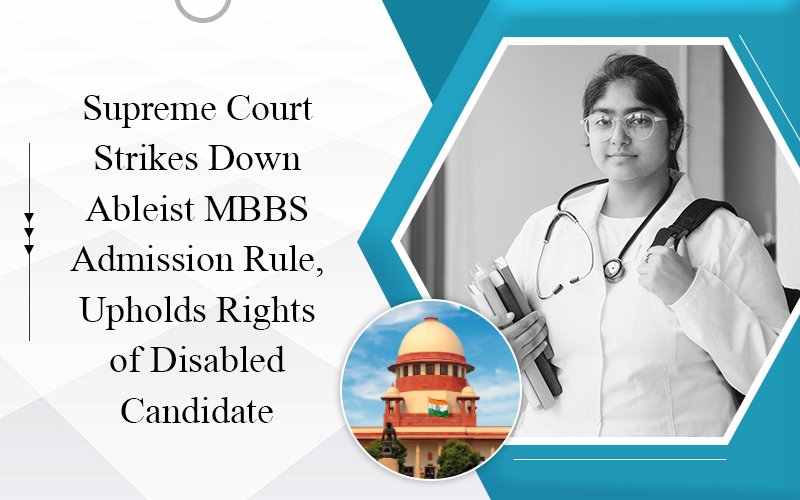
The Supreme Court of India recently upheld the MBBS admission of a candidate with disabilities, strongly criticizing the requirement that medical students must have “both hands intact.” The Court ruled that such a prescription is discriminatory and violates constitutional rights and disability laws. The case involved a candidate with locomotor and speech disabilities, who had an outstanding academic record and qualified for the MBBS course under the PwD category in the NEET-UG 2024 examination. Despite securing a rank well above the cut-off, the Disability Assessment Board (DAB) declared him ineligible for medical studies without conducting a proper functional assessment. His writ petition challenging this decision was dismissed by the Punjab and Haryana High Court, prompting him to approach the Supreme Court.
A two-judge bench comprising Justices B.R. Gavai and K.V. Viswanathan ruled in favor of the appellant, stating that the “both hands intact” rule was unconstitutional, ableist, and contrary to the principles of reasonable accommodation. The Court highlighted that this requirement contradicted:
- Article 41 of the Constitution, which guarantees the right to work and education for people with disabilities.
- The UN Convention on the Rights of Persons with Disabilities, which prohibits discrimination based on disability.
- The Rights of Persons with Disabilities Act, 2016 (RPwD Act), which mandates equal opportunities and reasonable accommodation for disabled individuals.
The Court noted that the assessment board’s decision lacked transparency, as it did not explain how the appellant was functionally unfit for the medical course. It pointed out that a “one size fits all” approach to medical eligibility was unjust and that each case should be assessed individually. The Court stated that the board seemed constrained by the “both hands intact” rule, which glorifies ableism and unfairly favors individuals with typical physical abilities. It ruled that this prescription had no legal sanctity, as it failed to consider individual functional assessments. The Supreme Court relied on previous rulings in Omkar Ramchandra Gond and Om Rathod, emphasizing that arbitrary medical standards must be revised to ensure inclusivity.
Accordingly, the Court:
- Confirmed the appellant’s MBBS admission to Government Medical College, Sirohi, Rajasthan.
- Directed the National Medical Commission (NMC) to revise its guidelines on disability assessment in medical admissions and file an affidavit on its progress by March 3, 2025.
This landmark judgment reinforces the rights of persons with disabilities, ensuring that arbitrary and outdated medical standards do not obstruct their educational and professional aspirations.