SULEMAN SAMAD [Petitioner] Vs. STATE OF N.C.T. OF DELHI [Respondent]
(CORAM: HON’BLE MS. JUSTICE SWARANA KANTA SHARMA)
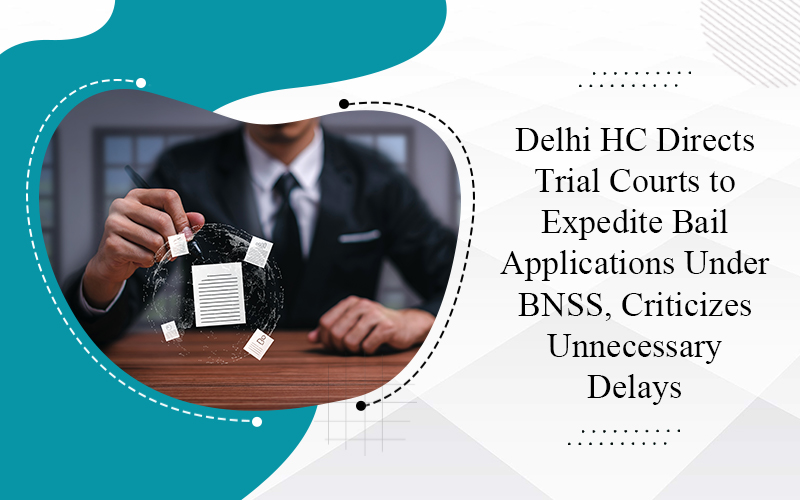
The Delhi High Court has directed trial courts to promptly decide bail applications under Section 479 of the Bharatiya Nagarik Suraksha Sanhita (BNSS), 2023, rather than unnecessarily adjourning them. This ruling came while hearing the bail plea of a 60-year-old accused in a POCSO case. The case was filed based on a complaint by the victim’s mother. The High Court observed that trial courts must ensure timely decisions, particularly for undertrial prisoners who have already served half of the maximum imprisonment applicable to their alleged offence.
Justice Swarana Kanta Sharma, presiding over the case, emphasized that if a judge handling such matters goes on leave, the case should be immediately brought to the attention of the Link Judge so that it is listed on priority. The Court stated that it would be beneficial for court staff to be instructed to inform the Link Judge about such cases to ensure they are heard at the earliest opportunity.
Under Section 479 of BNSS, undertrial prisoners who have already served half of the maximum sentence for offences that do not carry a death or life imprisonment penalty are entitled to bail. Moreover, first-time offenders must be granted bail if they have completed one-third of the maximum possible sentence upon conviction. The petitioner was represented by Advocate Shikhar Khare, while the State was represented by Additional Public Prosecutor (APP) Raj Kumar.
The High Court was hearing the bail plea of a 60-year-old accused in a POCSO case. He had been in custody for over 18 months and sought bail on the grounds of old age and health issues, arguing that he met the criteria set under Section 479 of BNSS. Despite the jail authorities sending a letter to the trial court in December 2024, confirming that the accused had completed one-third of the maximum sentence, the trial court continued to adjourn the matter. The accused’s counsel highlighted that the bail application, which was filed in November 2024, had remained pending due to unwarranted delays.
The High Court criticized the trial court’s repeated adjournments, stating that it was expected to promptly decide bail applications in compliance with Section 479 of BNSS. The Court noted that even when the presiding judge was on leave on multiple dates—December 11, 13, 20, and January 8—the matter should have been taken up on the next available date or a shorter adjournment should have been given. The Court further noted that the accused had been in custody for approximately one year and ten months, and the victim and her mother had not appeared in court to give evidence. The High Court condemned the trial court’s approach, pointing out that despite receiving a report confirming the accused’s previous involvement, the matter was still adjourned for nearly 20 days.
The High Court directed the trial court to decide the bail application within seven days. It stressed that timely decisions on bail applications must be ensured to uphold the rights of undertrial prisoners. The Registry was also instructed to communicate the order to the trial court by the next day, including through electronic means. With these directions, the bail application was disposed of.