GODREJ PROJECTS DEVELOPMENT LIMITED [APPELLANT(S)] Vs. ANIL KARLEKAR & ORS. [RESPONDENT(S)]
CIVIL APPEAL NO. 3334 OF 2023
(2JB, B.R. GAVAI and S.V.N. BHATTI JJ., delivered by B.R. GAVAI, J.)
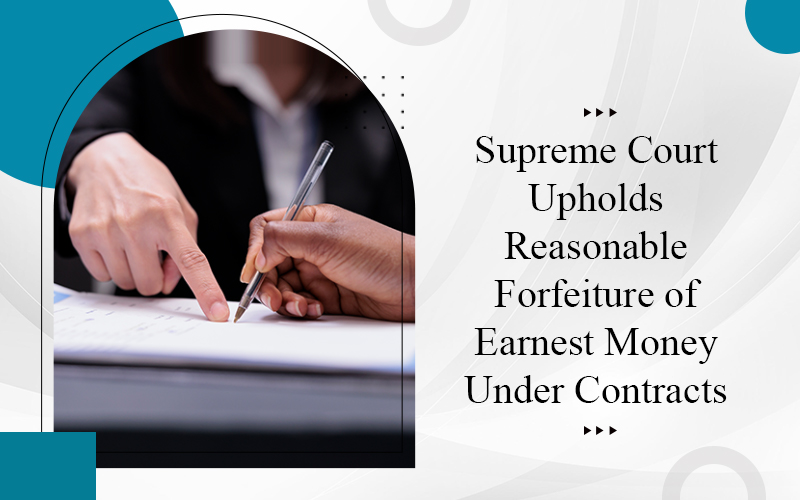
The Supreme Court of India recently ruled that if the forfeiture of earnest money under a contract is reasonable, it does not fall within the purview of Section 74 of the Indian Contract Act, 1872 (ICA), as it does not constitute a penalty. The judgment came in response to a Civil Appeal against the National Consumer Disputes Redressal Commission (NCDRC), which had disposed of a consumer complaint concerning the forfeiture of earnest money.
A two-judge bench comprising Justice B.R. Gavai and Justice S.V.N. Bhatti observed that if a contract stipulates the forfeiture of a reasonable sum as earnest money, it does not amount to a penalty. However, if the forfeiture is excessive and resembles a penalty, then Section 74 of the ICA would apply. The court noted that when a party in breach of a contract is required to forfeit a sum already paid, such forfeiture must be examined to determine whether it is of a penal nature.
In 2014, the complainants booked an apartment in the “Godrej Summit” project by submitting an application and paying ₹10,00,000 as an initial deposit. Subsequently, the developer allotted an apartment on the 14th floor in Tower C, and both parties signed an Apartment Buyer Agreement. Upon completion of construction, the developer received the Occupation Certificate and offered possession of the apartment to the complainants.
However, instead of taking possession, the complainants sought the cancellation of the allotment and demanded a full refund of ₹51,12,310, which they had paid towards the apartment. In 2017, they sent a legal notice demanding a refund, followed by a consumer complaint before the NCDRC, seeking repayment along with 18% interest per annum.
The NCDRC ruled in favor of the complainants, directing the developer to deduct 10% of the Basic Sale Price (BSP), which amounted to ₹17,08,140, as cancellation charges. The remaining amount of ₹34,04,170 was to be refunded along with 6% simple interest per annum. In 2022, the NCDRC dismissed the developer’s review petition, prompting an appeal before the Supreme Court.
While issuing notice in the appeal, the Supreme Court granted a stay on the NCDRC order, on the condition that the developer refunds the amount after deducting 20% as earnest money. The court examined past rulings, including the case of DLF Ltd. v. Bhagwanti Narula, where the NCDRC had consistently held that forfeiting 10% of the BSP is reasonable.
The Court found no reason to overturn this precedent but disagreed with the NCDRC’s decision to award interest on the refund amount. The judges noted that the complainants canceled their allotment due to a decline in property prices, which might have allowed them to purchase a similar property at a lower price.
Consequently, the Supreme Court modified the NCDRC’s order, directing the developer to refund ₹12,02,955 to the complainants within six weeks, without additional interest. The judgment reaffirmed that reasonable forfeiture of earnest money does not attract Section 74 of the ICA, unless it is punitive in nature.