GAUTAM KUMAR DAS [APPELLANT(S)] nVs.nnNCT OF DELHI AND OTHERS [RESPONDENT(S)]
CRIMINAL APPEAL NO. OF 2024 (Arising out of SLP(Criminal) No. 5171 of 2024)
(2JB, B.R. GAVAI and K.V. VISWANATHAN JJ., delivered by B.R. GAVAI J.)
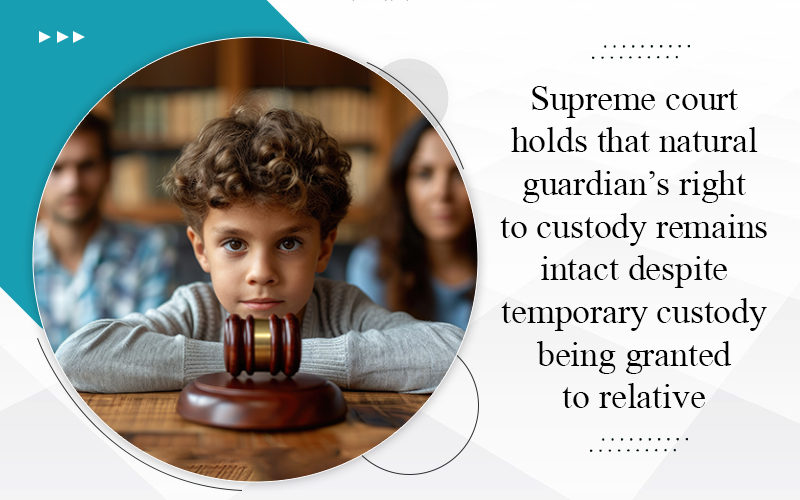
The Supreme Court of India ruled that a natural guardian’s right to custody of a child is not lost simply because temporary custody was granted to a relative. This decision came in a case where a father, after the death of his wife during COVID-19, had temporarily entrusted his minor daughter to his sisters-in-law for care. Later, after remarrying, the father sought to regain custody, arguing that he and his new wife could now adequately care for the child.
The Court, led by Justices BR Gavai and KV Viswanathan, emphasized that the temporary custody arrangement did not diminish the father’s right as the natural guardian. The Court found that the father, a well-educated government official, was capable of providing for his daughter and that it was in the child’s best interest to be with her natural family. The ruling was supported by the precedent set in the case of Tejaswini Gaud v. Shekhar Jagdish Prasad Tewari, where the Court similarly upheld the natural guardian’s right to custody.
The appeal challenged a Delhi High Court order from April 3, 2024, which directed the appellant (a father) to seek custody of his minor daughter through the family court. The appellant had temporarily given custody of his children to his sister-in-law after his wife and father died from COVID-19. Although he later regained custody of his son, his sister-in-law refused to return his daughter, even relocating her to West Bengal. After remarrying, the appellant sought custody but was denied. The High Court offered visitation rights and referred the case to mediation, leading to the current appeal.
Shri Agrawal, representing the appellant, argued that the Delhi High Court erred in dismissing his client’s petition for custody of his daughter, Sugandha Das. He emphasized that the appellant is the sole surviving biological parent and natural guardian, while the respondents, Sugandha’s aunts, have no legal rights. Agrawal contended that the High Court’s decision contradicts a Supreme Court precedent and stressed that it is in the child’s best interest to live with her father in Delhi, where she would be with her biological brother. Shri Sharma, for the respondents, argued that the appellant’s prior withdrawal of a custody petition should bar him from filing a habeas corpus petition and alleged past mistreatment of the appellant’s late wife.
The Court ruled that the temporary custody of minor Sugandha Das by her aunts due to unfortunate circumstances does not justify denying custody to the appellant, her natural guardian. The Court dismissed the allegations against the appellant as an afterthought, made after he sought custody. It emphasized that there is no strict formula for deciding custody cases and that the welfare of the child is paramount. The Court concluded that it is in Sugandha’s best interest to live with her natural family, leading to the decision to grant custody to the appellant.