STATE OF GUJARAT [Appellants] Vs. SHASHIKANT GORDHANBHAI PATEL & ORS [Respondent]
R/CRIMINAL APPEAL NO. 816 of 1999
(2JB, HONOURABLE MR. JUSTICE ILESH J. VORA and HONOURABLE MR. JUSTICE NIRAL R. MEHTA)
Facts: The present Appeal by the State is against the judgment and order of acquittal, Being dissatisfied by the judgment and order passed by the learned Additional Sessions Judge, Kheda, Camp at Anand, dated 12.04.1999, acquitting the respondents from the offence under Sections 302, 323, 365, 342, 147, 148, 149 of Indian Penal Code, State has preferred instant appeal under Section 378 of the Cr.P.C.
Issue: Whether oral dying declaration is deemed truthful?
Arguments on behalf of counsel for appellant:
Mr. L.B. Dabhi, learned Additional Public Prosecutor appearing for the appellant – State assailing the judgment and order of acquittal, has submitted that the findings of acquittal are contrary to law and evidence on record and the findings recorded are palpably erroneous and based on the irrelevant material. The learned trial Court ought to have considered the oral dying declaration of the deceased, which had been disclosed by the deceased voluntarily and at relevant time, he was in fit state of mind. The witness Janardan Mahida – PW-16 is an independent witness and he has no reason to falsely involved the accused. In such circumstances, the trial Court, while acquitting the accused discarded the material evidence and has committed error of law while coming to the conclusion that prosecution miserably failed to prove its case.
Arguments on behalf of counsel for respondent:
On the order hand, learned counsel appearing for the respondents accused have submitted that the High Court in a case of Appeal against the acquittal, can interfere only when there are compelling substantial reasons for doing so and more particularly, the findings are without reasons and unreasonable and contrary to the evidence. In the facts of the present case, there is no direct evidence. The evidence available is the oral dying declaration before the police officials, PW-16, which has not been relied by the trial Court, as it does not inspire confidence. The deceased Arvind was semi-unconscious state of mind and when he brought to the hospital, the doctor declared him ‘brought dead’. The medical evidence clearly established that, the deceased was not able to speak because of the injuries. In such circumstances, the trial Court has rightly disbelieved the oral dying declaration.
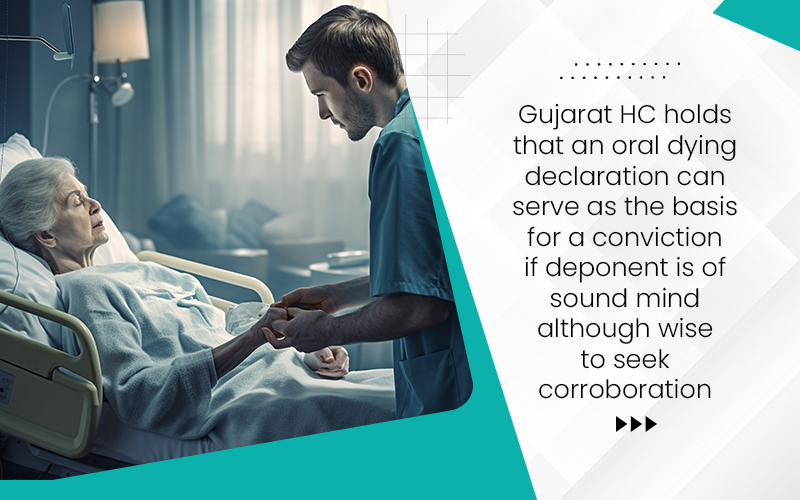
Held: The court dismissed the present appeal and held that, “The law is well settled that an oral Dying Declaration can form the basis of conviction if the deponent is in fit condition to make the declaration and if it is found to be truthful. The Courts as a matter of prudence look for corroboration to oral Dying Declaration. However, if there exists any suspicion as regards the correctness or otherwise of the said Dying Declaration, the Courts in arriving at the conclusion of conviction, shall look for some corroborating evidence.”