Sita Soren [Appellant] Vs. Union of India [Respondent]
(Criminal Appeal No. 451 of 2019)
(7JB, DY Chandrachud, A.S. Bopanna, M.M. Sundresh, PV Narasimha, J.B. Pardiwala, Sanjay Kumar, Manoj Misra JJ.)
Facts: The Criminal Appeal arises from a judgment dated 17 February 2014 of the High Court of Jharkhand. An election was held on 30 March 2012 to elect two members of the Rajya Sabha representing the State of Jharkhand. The appellant, belonging to the Jharkhand Mukti Morcha, was a member of the Legislative Assembly of Jharkhand. The allegation against the appellant is that she accepted a bribe from an independent candidate for casting her vote in his favour. However, as borne out from the open balloting for the Rajya Sabha seat, she did not cast her vote in favour of the alleged bribe giver and instead cast her vote in favour of a candidate belonging to her own party. The present appeal interprets the correctness of the judgment passed in PV Narasimha Rao v. State (CBI/SPE) case
Issue: Whether by virtue of Articles 105 and 194 of the Constitution a Member of Parliament or the Legislative Assembly, as the case may be, can claim immunity from prosecution on a charge of bribery in a criminal court?
Arguments on behalf of counsel for appellant:
The overruling of long-settled law in PV Narasimha Rao is unwarranted according to the tests laid down by this court on overturning judicial precedents. The object behind conferring immunity on MPs and MLAs was to shield them from “being oppressed by the power of the crown”. The apprehension of parliamentarians being arrested shortly before or after the actual voting or making of a speech in the Parliament was the precise reason for introducing the concept of privileges and immunities. The concept of constitutional privileges and immunities is not in derogation of the Rule of Law, but it is a distinct feature of our constitutional structure. The majority judgment preserves the privilege of MPs and MLAs to protect their dignity as legislators and is not opposed to the rule of law. The majority judgment gave due regard and recognition to Parliament’s exclusive powers to take appropriate steps against corrupt practices by its members, just as the Parliament recognizes the limits on discussions in the House, such as the inability to entertain discussions on the conduct of judges of constitutional courts under Article 121 of the Constitution.
Arguments on behalf of counsel for respondent:
Mr Venkataramani, the learned Attorney General for India advanced a preliminary submission that the decision in PV Narasimha Rao is inapplicable to the instant case. He submitted that the exercise of franchise by an elected member of the legislative assembly in a Rajya Sabha election does not fall within the ambit of Article 194(2), and thus, PV Narasimha Rao does not have any application to the present case. He submits that the objective of Article 194(2) is to protect speech and conduct in relation to the functions of the legislature. Therefore, any conduct which is not related to legislative functions, such as the election of members to the Rajya Sabha, will fall outside the ambit of Article 194(2). According to the learned Attorney General, the election of members to the Rajya Sabha is akin to any other election process and cannot be treated as a matter of business or function of the legislature
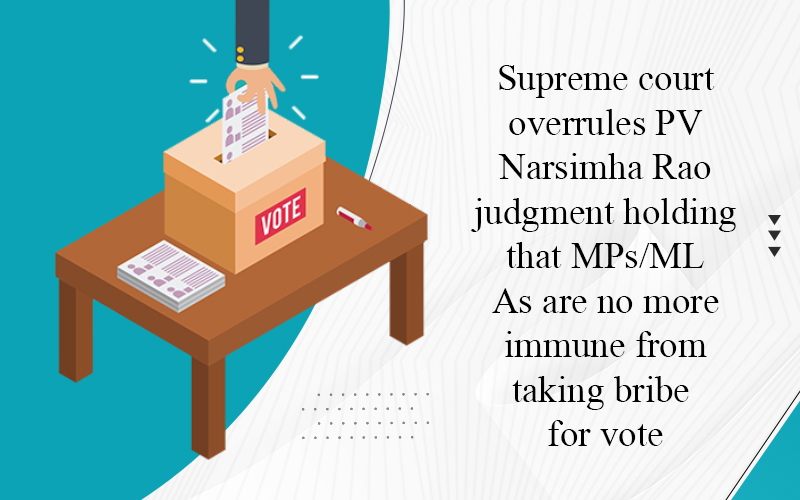
Held: The court overruled the judgement in the case of PV Narsimha and held that, “judgment of the majority in PV Narasimha Rao which grants immunity from prosecution to a member of the legislature who has allegedly engaged in bribery for casting a vote or speaking has wide ramifications on public interest, probity in public life and parliamentary democracy. There is a grave danger of this Court allowing an error to be perpetuated if the decision were not reconsidered…. the offence of bribery is agnostic to the performance of the agreed action and crystallizes on the exchange of illegal gratification. It does not matter whether the vote is cast in the agreed direction or if the vote is cast at all. The offence of bribery is complete at the point in time when the legislator accepts the bribe; and. The interpretation which has been placed on the issue in question in the judgment of the majority in PV Narasimha Rao results in a paradoxical outcome where a legislator is conferred with immunity when they accept a bribe and follow through by voting in the agreed direction. On the other hand, a legislator who agrees to accept a bribe, but eventually decides to vote independently will be prosecuted. Such an interpretation is contrary to the text and purpose of Articles 105 and 194.”