MOHD ABAAD ALI & ANR. (APPELLANTS) Vs. DIRECTORATE OF REVENUE PROSECUTION INTELLIGENCE (RESPONDENT)
CRIMINAL APPEAL ARISING OUT OF SLP (CRL.) NO. 2052 OF 2017
(2JB, SUDHANSHU DHULIA and VARALE JJ., delivered by SUDHANSHU DHULIA, J.)
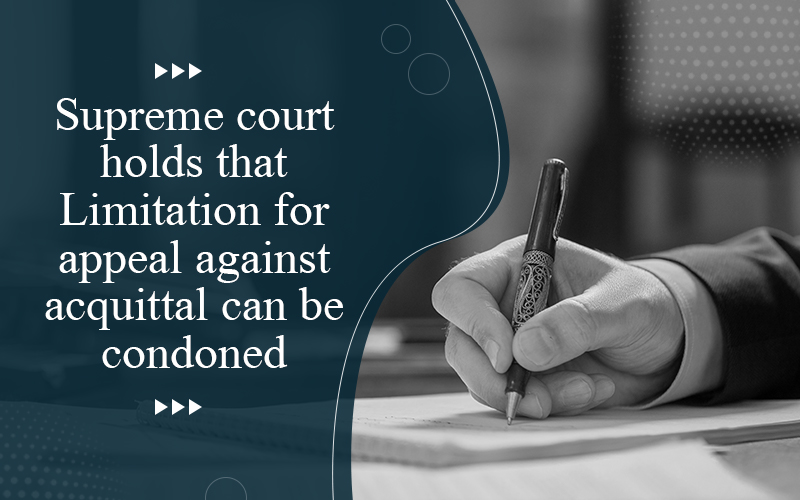
Facts: Against the order of acquittal, the Directorate of Revenue Intelligence filed an appeal before the High Court on 27.06.2013. That appeal against acquittal filed under Section 378 of CrPC was accompanied by a delay condonation application, since the appeal was belated by 72 days. The delay condonation application was allowed by the Delhi High Court on 18.05.2016. An application was then moved by the present appellant before the High Court under Section 482 of CrPC for recalling of the said order on grounds that Section 5 of the Limitation Act would not apply in case of an appeal against acquittal since the period of filing an appeal against acquittal, has been prescribed under Section 378(5) of CrPC itself, where there is no provision for condonation of delay. By order dated 20.01.2017 the Delhi High Court nonetheless dismissed the application for recall filed by the appellant, although no reasons were assigned while dismissing the application under Section 482. This order has been challenged before the present court.
Issue: Whether the provisions of Section 5 of the Limitation Act, 1908 (i.e. Act 9 of 1908 i.e. the old Limitation Act) would apply to an application for special leave to appeal from an order of acquittal under sub-section 3 of Section 417 of the old CrPC?
Arguments on behalf of counsel for appellants:
The learned counsel for the appellant Mr. Vijay Kumar Aggarwal, has relied upon the judgment of this Court in Kaushalya Rani v. Gopal Singh (1964). Kaushalya Rani had filed a case against one Gopal Singh under Section 493 IPC and alternatively under Section 496 IPC, alleging that Gopal Singh had deceitfully made her believe that he is her lawfully married husband and thus had sexual intercourse with her. Gopal Singh faced a trial in which he was acquitted by the Trial Court and an appeal against acquittal was filed by Kaushalya Rani under the Code of Criminal Procedure, 1898 (hereafter referred to as the “old CrPC”), under Section 417. The appeal was filed beyond the period of 60 days as provided under sub-section (4) of Section 417, i.e., the then prevailing Criminal Procedure Code. The appeal was dismissed on grounds of limitation 4 by the Punjab & Haryana High Court. This matter was thus taken by Kaushalya Rani before this Court.
Held: The court dismissed the present appeal and held that, “In the present case, there is no exclusionary provision under Section 378 of CrPC, or at any other place in the Code. The benefit of Section 5 read with Sections 2 and 3 of the Limitation Act, 1963 can therefore be availed in an appeal against acquittal. There is no force in the contentions raised by the appellants as regards the non-application of Section 5 of the Limitation Act in the present case and the appeal is therefore dismissed.”