RAMADHAR SAHU [Appellant(s)] Vs. THE STATE OF MADHYA PRADESH [Respondent(s)]
CRIMINAL APPEAL Arising from SLP(Crl.) No (s).11130/2023
(2JB, ANIRUDDHA BOSE and BELA M. TRIVEDI JJ.)
Facts: appellant was released on bail on deposit of Rs.10,00,000/. The appellant had failed to deposit the remaining amount and surrendered on 24.07.2023. He applied for bail again mainly citing release of a co accused by this Court on 01.05.2023 in SLP (Crl.) No. 3158 of 2023. The said co accused was earlier released on bail by the High Court on his willingness to deposit certain sum of money but later on failed to make such deposit. The appellant’s fresh application for bail was refused by the High Court. The appellant sought parity with the co accused in the application which was rejected. In the order rejecting his application for bail, the High Court referred to Section 362 of the Code of Criminal Procedure, 1973. The opinion of the High Court, in the impugned order, is that in the event the High Court granted bail to the appellant without compliance of the conditions specified in the earlier order of a Coordinate Bench, that would constitute modification of the order and Section 362 of the Code prohibits such modification of a judgment or final order.
Issue: Whether granting bail to the appellant by the high court without compliance of the conditions specified in the earlier order of a Coordinate Bench, would constitute modification of the order and Section 362 of the Code prohibits such modification of a judgment or final order?
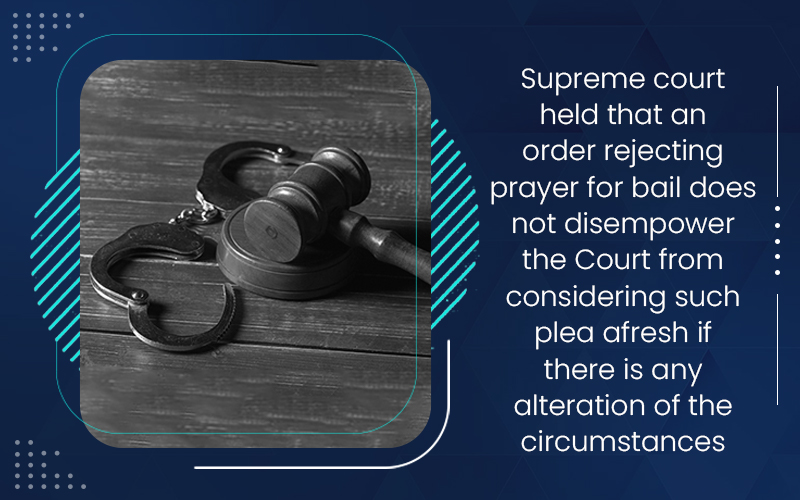
Held: The court allowed the present appeal and held that, “an order for refusal of bail however, inherently carries certain characteristics of an interlocutory order in that certain variation or alteration in the context in which a bail plea is dismissed confers on the detained accused right to file a fresh application for bail on certain changed circumstances. Thus, an order rejecting prayer for bail does not disempower the Court from considering such plea afresh if there is any alteration of the circumstances. Conditions of bail could also be varied if a case is made out for such variation based on that factor. Prohibition contemplated in Section 362 of the Code would not apply in such cases. Hence, we do not think the reasoning on which the impugned order was passed rejecting the appellant’s application of bail can be sustained. The impugned order is set aside and the matter is remitted to the High Court. The bail petition of the appellant before the High Court shall revive to be examined afresh by the High Court in the light of our observations made in this order.”