PRADEEP MEHRA [APPELLANT] Vs. HARIJIVAN J. JETHWA [RESPONDENTS (SINCE DECEASED THR. LRS.) & ORS]
(CIVIL APPEAL NO. 6375 OF 2023)
(2JB, SANJAY KISHAN KAUL and SUDHANSHU DHULIA JJ., delivered by SUDHANSHU DHULIA, J.)
Facts: The present appeal shows how the execution proceedings under Order XXI of the Code of Civil Procedure, 1908 are being delayed, and the process is being abused in the execution proceedings, to the peril of the helpless decree holder.
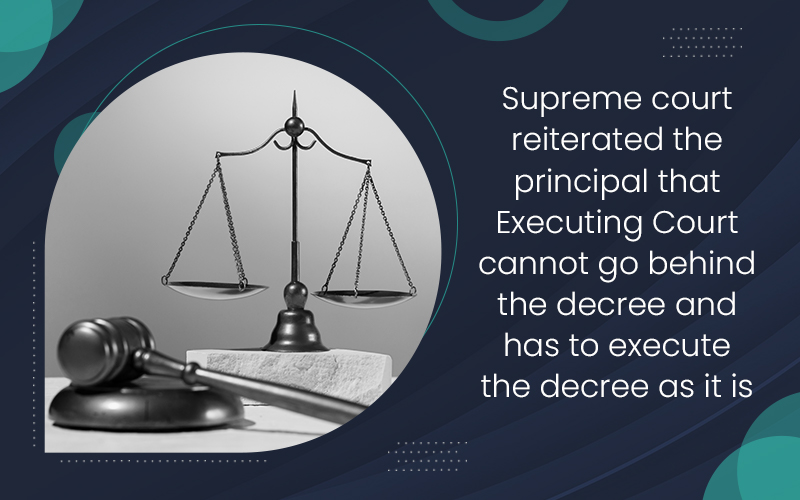
Issue: Whether the executing court can go behind the decree or execute it as it is?
Arguments on behalf of counsel for appellant:
The decree holder moved a petition before the Bombay High Court under Article 226/227 of the Constitution of India and the main ground taken before the High Court was that the revisional court fell into an error in holding that the application moved by the judgment debtors for setting aside the order dated 12.02.2013 comes within the purview of the power of the executing court given to it under Section 47 of the CPC. It was submitted by the decree holder before the High Court that the order dated 12.02.2013 had attained finality and res judicata would apply against the judgment debtors. In support of the submission the decree holder relied upon a decision of this court given in Barkat Ali & Anr. vs. Badrinarain (D) by Lrs. 2008 (4) SCC 615, where this court reiterated the settled position of law that the principles of res judicata are not only applicable in respect of separate proceedings but the general principles of res judicata are also applicable at the subsequent stage of the same proceedings and therefore the same court will be precluded to go into that question which has already been decided, or deemed to have been decided by it in the earlier stage. In other words, it will be barred by the principle of res judicata, or at least by the principle of constructive res judicata. The logic here is that an execution proceeding works in different stages and if the judgment debtors have failed to take an objection and have allowed the preliminary stage to come to an end and the matter has moved to the next stage, the judgment debtors cannot raise the objection subsequently, and revert back to an earlier stage of the proceeding.
Held: The court allowed the appeal and held that, “The High Court, to our mind, committed an error by not interfering in the matter. To our mind this case has unnecessarily been dragging on for so long; which is for nearly two decades. The order dated 22.12.2017 by the Appellate Court and the order dated 08.01.2021 by the High Court are not sustainable in the eyes of law. We therefore allow the appeal and set aside the order of the High Court dated 08.01.2021 and the order of the appellate court dated 22.12.2017, while we uphold the order of the executing court dated 28.09.2017. The executing court is hereby directed to proceed with and complete the execution as expeditiously as possible, but at any event within a period of six months from the date a copy of this order is placed before the court. The interim order dated 27.07.2021 hereby stands vacated.”