Madras Bar Association v. Union of India
Writ Petition (C) No. 626 of 2021
Chief Justice BR Gavai and Justice K. Vinod Chandran
Overview
The Supreme Court determined that the Receivership Act was in violation of the Constitution of India, was unconstitutional because it violated established principles concerning the separation of powers and the independence of the judiciary. The Court recognised that Dr B.R. Ambedkar’s statement in the Constituent Assembly outlined the standards by which it would operate. The Court will continue to operate within the guidelines provided by the Constitution, as long as the Parliament has enacted legislation about Tribunals, and the provisions of that legislation do not dilute judicial independence, nor do they limit access to the courts to seek protection under Articles 32, 136, 226, and 227.
Facts and Circumstances of the Case
The Petitioners are challenging various provisions of the Tribunals Reforms Act, 2021, which were enacted despite this Court’s ruling on similar provisions with the same wording in prior cases. The provisions that were most contentious regarding the Act are as follows:
- The age limit for appointment as a member or Chairperson of the Tribunals is at least 50 years; and
- The Term of Office is four years, with maximum ages of 67 (Member) and 70 (Chairperson).
- Executive-dominated Search-cum-Selection Committees (SCSCs).
- Provisions giving discretion to the Central Government in appointments and re-appointments.
- Re-enactment of provisions previously struck down raises the issue of legislative override of judicial decisions.
The petitioners thus contended that these provisions compromised tribunal independence and granted the executive excessive control, violating Article 14 and the basic structure of the Constitution.
Legal Issues
- Whether Parliament can re-enact provisions already declared unconstitutional?
- Whether the Act, by providing too much executive discretion in appointments and tenure and reappointments, violates judicial independence.
- Whether the fixation of minimum age at 50 years is arbitrary and contrary to the earlier judgments?
- Whether prescribing a tenure of only four years infringes upon institutional independence?
- Whether the Search-cum-Selection Committee’s composition and powers meet the constitutional standards?
Decision of the Court
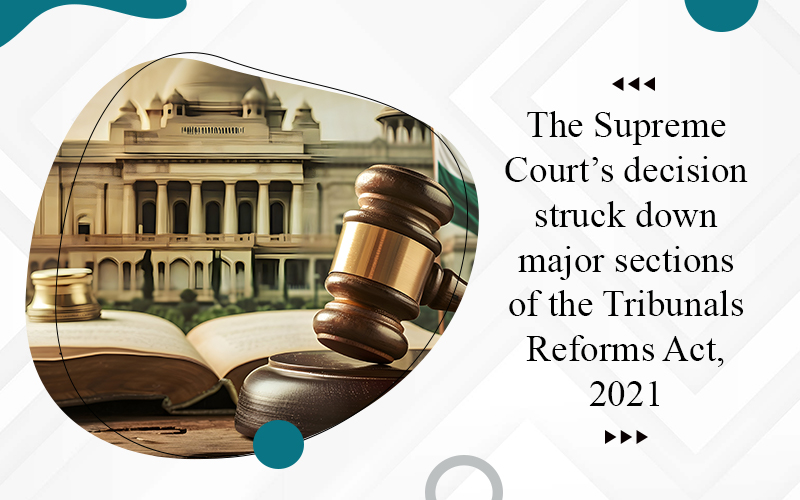
The Supreme Court decided to strike down parts of the Tribunals Reforms Act of 2021. It said that some sections went against judicial independence. That is a key part of the basic structure doctrine. The court threw out the rule requiring people to be at least 50 years old for appointments. It also got rid of the brief four-year term for those roles. Plus, it rejected any setup that let the executive branch control the Search-cum-Selection Committees too much. Still, the court agreed that Parliament has the right to make laws about tribunals. But it made clear that this authority cannot keep bringing back rules that got struck down before. The parts about removing tribunal members stayed in place. Those come with protections like giving notice and a chance to be heard. The court stressed the need for judges to lead in making appointments. It also pushed for longer terms to keep tribunals independent and working well.