Reliance Eminent Trading and Commercial Pvt. Ltd. {Appellants } Vs. Delhi Development Authority {Respondent}
CIVIL APPEAL NO. OF 2026
(Arising out of Special Leave Petition (C) No. 22100 of 2025)
(SJB, J.B. Pardiwala, J.)
Overview
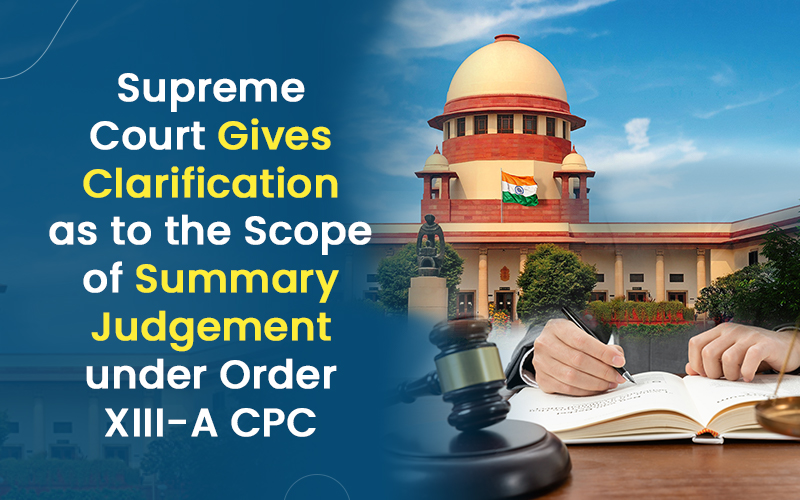
This case came before the Supreme Court as a civil appeal arising out of the refusal of the High Court of Delhi for granting summary judgement under Order XIII-A of the Code of Civil Procedure.
The dispute arose out of a land auction where the appellant paid complete consideration, but the underlying land acquisition lapsed.
The important question raised was whether the claim by the appellant as to the refund could be decided summarily, or whether issues pertaining to possession require an entire trial.
The Court had to examine whether the defence by the respondent had real substance or was merely a move to delay proceedings.
Facts of the Case
The Delhi Development Authority(DDA), the respondent herein, auctioned a commercial plot in March 2007 in Jasola, New Delhi. The appellant i.e., Reliance Eminent Trading and Commercial Pvt. Ltd., was the highest bidder and paid a consideration of around ₹164 crores within the given amount of time. In February 2008, a conveyance deed was issued and the appellant paid stamp duty, and property taxes over the years.
Unbeknownst to the appellant, the acquisition was already challenged by the original landowner. The Delhi High Court declared the acquisition to have lapsed due to non-payment of the compensation in November 2016. This was upheld by the Supreme Court on 4 May 2017 and DDA was granted six months to initiate fresh acquisition proceedings.
Since DDA failed to act within the time given, the lapse was made final. Subsequent curative petitions and reviews were also dismissed. During this period, the appellant also faced trespass over the property and was completely unaware of the legal development for a period.
After the representations went unanswered, a suit was filed by the appellant in 2020 seeking refund of the entire amount along with interest. An application for the summary judgement was filed, but it was dismissed by the High Court while holding that the issue pertaining to possession requires an entire trial. Aggrieved by the same, the appellant approached the Supreme Court.
Legal Issues
- Whether the appellant, under Order XIII-A CPC, was entitled to a summary judgement.
- Whether the lapse of land acquisition automatically took away DDA’s title over the property.
- Whether the claim as to refund by the appellant could be made without handing back the possession of the plot.
- Whether the issue of limitation could be decided at the stage of summary judgement without requiring any oral evidence.
- Whether the earlier judicial findings as to the lapse of acquisition, prevented the respondent from raising the same issues again.
Decision
The appeal was allowed by the Supreme Court and the High Court’s refusal to grant summary judgement was set aside.
It was held that once the acquisition proceedings had lapsed and was finalised, the respondent did not have any right in the land. In such scenarios, a party insisting on the return of the possession, before the refund, was legally untenable. The Court observed that such defence did not raise any issue which required a full trial.
As to the issue of limitation, it was clarified by the court that the cause of action only arose after the six-month period, granted for the fresh acquisition, expired, which was 4 November 2017. Therefore, the suit which was filed in 2020, was within time and did not require an entire trial for determination.
The Court, further examining the purpose of Order XIII-A CPC, emphasised that summary judgement should be granted where the defence do not have any real prospect of success. Allowing such matters to proceed with full trial, only delays justice.
Accordingly, the suit was decreed in the favour of the appellant and refund of the sale consideration with interest was ordered, while holding that the appellant cannot be made to bear the consequences of the failure on part of the authority.