Prahlad Sahai {Appellant(s) } Vs. Haryana Roadways & Anr. {Respondent(s)}
Civil Appeal No. 4642 OF 2026
(@ Special Leave Petition (C) No. 8756 of 2024)
(SJB, K.V. Viswanathan, J.)
Overview
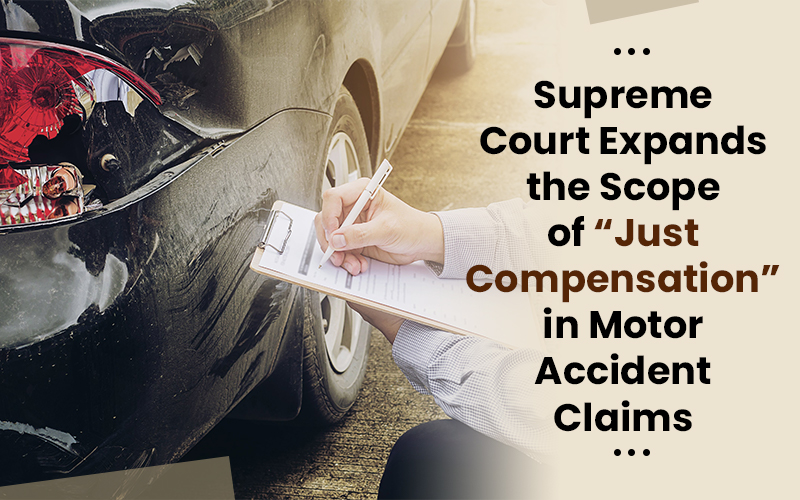
The case arose out of a motor accident claim pertaining to the manner in which the courts are required to calculate compensation for amputees requiring prosthetic limbs.
The appeal came before the Supreme Court against a judgement by Rajasthan High Court, which enhanced the compensation which was granted to the claimant, but failed to take into account future prosthetic expenses arising from permanent disability.
The Supreme Court had to examine the way in which courts should assess “just compensation” under the Motor Vehicles(MV) Act in cases involving loss of livelihood and permanent disability.
Facts of the Case
On 2 May 2007 the appellant, Mr. Prahlad Sahai, was travelling as a pillion rider on a motorcycle in Jaipur. A Haryana Roadways (the respondent herein) bus hit the motorcycle from behind, causing severe injuries to the appellant due to which his right leg had to be amputated below the knee.
When the accident occurred, the appellant was 32 years old and worked as a heavy vehicle driver. It was claimed by him that he earned ₹6000 per month. However, both the Rajasthan High Court as well as the Motor Accident Claims Tribunal considered his income to be ₹4500 since no documentary evidence was produced.
At first, the appellant was awarded the compensation of approx ₹8.73 lakhs by the tribunal, which was later enhanced to around ₹13 lakhs by the High Court. No compensation, however, was granted as to future expenses for the prosthetic limbs or maintenance.
Aggrieved by the same, the appellant approached the Supreme Court while contending that the amputation completely destroyed his capacity to earn his livelihood as a driver.
Legal Issues
- Whether compensation towards the prosthetic limbs, forms part of “just compensation” under the Motor Vehicles Act.
- Whether absence of documentary proof as to income hinders reasonable assessment of income.
- Whether losing a limb, which results in inability to continue one’s profession, amounts to 100% functional disability.
Decision
The Supreme Court allowed the appeal and enhanced the compensation awarded earlier to the appellant by the High Court.
It was observed that a prosthetic limb cannot be merely treated as a medical device. It is an important part of restoring confidence and dignity for an amputee.
Referring to the principle of restitutio in integrum, it was held that the purpose of the compensation should be to restore the injured person to his original position if the accident never would have occurred.
As to the monthly income, the Court assessed it to be ₹6000 and held that documentary proof as to the same cannot always be expected from the workers part of an unorganised sector. It was further observed that even if the physical disability does not technically amount to 100%, the appellant’s functional disability as a driver was complete.
The Apex Court, while rejecting the rates prescribed under government notification, awarded compensation towards the future prosthetic and maintenance expenses. The compensation was enhanced by over ₹36 lakhs and above the amount which was already awarded by the High Court, along with directions for making the payment within four weeks.