Jai Prakash Saini {Appellant(s) } Vs. Managing Director, U.P. Cooperative Federation Ltd. & Ors. {Respondent(s)}
Civil Appeal No. Of 2025
Arising Out Of SLP(C) No. 2900/2020
(SJB, Delivered By Manoj Misra, J.)
Overview
In this matter, the Supreme Court addressed the question as to whether a departmental enquiry conducted without following the basic principles as to fairness can be considered legally valid. The appeal was filed by Jai Prakash Saini, who challenged his dismissal from the service, along with an order passed against him by his employer, the UP Cooperative Federation Limited.
The High Court earlier dismissed his petition, and it was held that the inquiry conducted against him was properly executed. The focus was placed on the allegations as well as on the question as to whether the actions of the employer were in line with the principles of natural justice and rules of service.
Facts of the Case
The appellant, Jai Prakash Saini, was working as an incharge at a paddy procurement centre. It was alleged that he purchased a large quantity of paddy, but did not deliver a huge portion of it to the designated mill. Later, an additional allegation was added, which stated that he also misused the money concerning the storage of processed paddy.
Based on these allegations, a departmental enquiry was conducted. The enquiry officer held that the charges pressed against the appellant were true, which led to his removal from the service and an order by his employer directing recovery of around ₹9.5 lakhs.
The appellant challenged this action before the High Court arguing that the inquiry wasn’t conducted properly, no hearing took place, no witnesses were examined, and no opportunity was given to him to defend himself. The High Court held that since no specific demand was made as to the cross examination or witnesses on the part of the appellant, the inquiry was valid.
The matter eventually reached the Supreme Court, and it became clear that the department did not examine any witnesses while conducting the inquiry. The employer, however, argued that the replies of the appellant were vague and they should be treated as an admission of the charges placed.
Legal Issues
- Whether it is necessary to conduct an oral enquiry when an employee denies the charges placed on him.
- Whether an employer must first produce evidence to prove the allegations placed on an employee.
- Whether the enquiry conducted against the appellant followed the principles of natural justice and rules as to service.
Decision
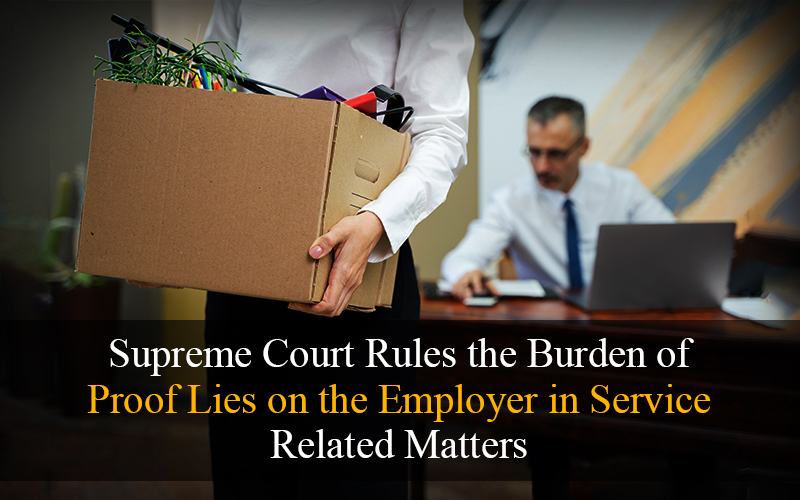
The Supreme Court allowed the appeal and held that the entire inquiry was flawed because there were absolutely no witnesses to prove the allegations placed by the employer, even though the charges were denied by the employee.
The Court clarified that in such a situation, the burden of proof lies on the employer to first prove the charges placed by producing proper evidence. Simply assuming that the employee is guilty based on vague replies is not enough to dismiss him from service. It was also stated that a reply cannot be treated as an admission of guilt unless there is clear acceptance of the allegations.
Emphasis was laid on a fair inquiry to be given to the employee, an opportunity to defend himself, and the right to cross examine the witnesses. Since none of this happened, the inquiry was considered to be invalid.
The Court finally gave the employer an option to conduct a fresh inquiry within six months. In the meantime, the appellant must be kept under suspension with allowance. If no inquiry is conducted, he would be entitled to a full reinstatement with salary and continuation of service.