Nilesh C. Ojha {Appellant(s) } Vs. High Court of Judicature at Bombay & Ors. {Respondent(s)}
CRIMINAL APPEAL NOS. 5673-5674 OF 2025
(DJB, Vikram Nath and Sandeep Mehta, JJ., Delivered by Sandeep Mehta, J.)
Overview
This case came before the Supreme Court after an advocate challenged certain orders passed by the Bombay High Court in a contempt matter. The High Court had taken suo motu action after the advocate made statements about a sitting judge in a press conference.
The real question here was not just about contempt, but about limits i.e., how far someone can go while criticising a judge, and when such criticism crosses the line. The Court had to see whether what was said publicly affected the dignity of the judiciary and whether the High Court acted properly in stepping in.
Facts of the Case
The issue began when the advocate filed a petition in the Bombay High Court asking for a CBI investigation into the death of his client’s daughter. The case was listed before a bench that included a judge referred to as Justice X.
Just a day before the matter was taken up in court, the advocate addressed the media. In that press conference, he made allegations suggesting that Justice X should not hear the case because of a personal connection linked to an FIR involving his client.
These statements did not go unnoticed. Justice X brought this to the attention of the Chief Justice, pointing out that her reputation had been affected. The High Court then took suo motu cognizance and formed a five-judge bench to look into the issue.
A notice was issued asking the advocate to explain why contempt proceedings should not be initiated. Instead of simply responding, the advocate filed applications asking that the judge be made a party to the case and also questioned the fairness of the bench itself.
The High Court rejected these requests. It also took note of further remarks made in those applications, which it felt were inappropriate. The advocate then asked for the entire bench to step aside, but this too was refused. After this, he approached the Supreme Court.
Legal Issues
- Whether the High Court exceeded its powers by starting contempt proceedings on its own.
- Whether a judge who reports such conduct becomes a necessary party in the case.
- Whether statements made as part of a legal argument can amount to contempt.
- Whether truth can be used as a defence in such cases.
- Whether the High Court can comment on professional misconduct of advocates.
Decision
The Supreme Court did not interfere and dismissed the appeal.
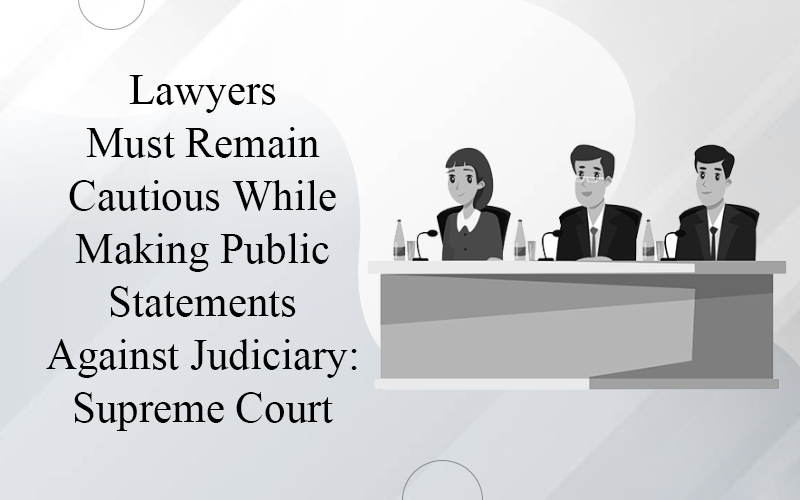
It made one thing very clear. People are free to criticise judges, but that freedom is not unlimited. The Court pointed out that making serious allegations in front of the media, especially when the matter is still pending, is not the right way to raise concerns.
The Court also stressed that lawyers carry a greater responsibility. Their actions are closely linked to the credibility of the legal system, and they are expected to act with restraint.
On the other points, the Court agreed that the judge did not need to be added as a party in the contempt case. It also found nothing wrong with the High Court considering the statements made during the proceedings.
At last, the Supreme Court stated that the High Court should continue with the matter and decide it on its own merits. It also clarified that it was not deciding whether the advocate was guilty of contempt, only that there was no reason to interfere at this stage.