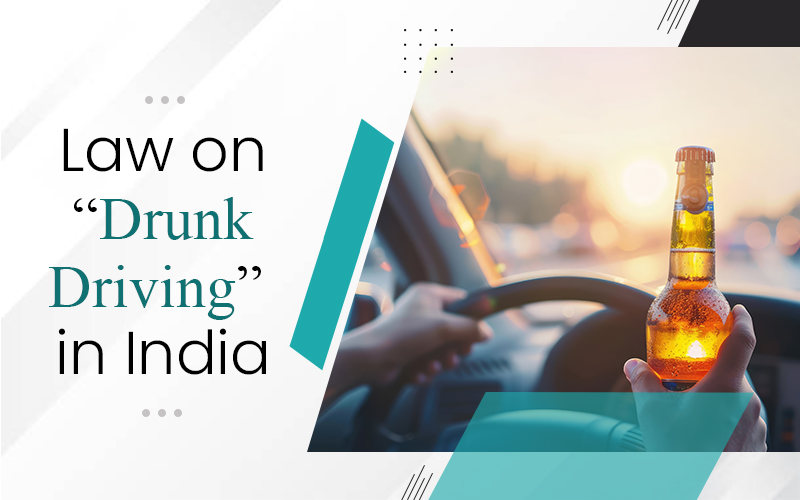
Drunk driving, also referred to as driving under the influence (DUI), is a major offense in India that endangers public safety. To curb this menace, the Indian government has implemented strict laws to penalize offenders and deter reckless driving. The primary legal provisions governing drunk driving are found in the Motor Vehicles Act, 1988, which has undergone several amendments to enhance penalties and enforcement.
Legal Limit for Alcohol Consumption
In India, the legal blood alcohol concentration (BAC) limit is 0.03% (30 mg of alcohol per 100 ml of blood). If a driver’s BAC exceeds this limit, they are considered to be driving under the influence of alcohol and are subject to legal action. To measure BAC, law enforcement agencies frequently conduct breathalyzer tests at checkpoints, especially during festivals or late at night when drunk driving incidents are more likely. The legal limit is lower in India compared to some other countries, reflecting the government’s focus on promoting road safety in a densely populated nation with a high number of traffic-related accidents.
Law and Penalties for Drunk Driving
The Motor Vehicles Act, 1988, particularly after the Motor Vehicles (Amendment) Act, 2019, outlines the offenses and penalties for drunk driving. Depending on the severity of the offense and whether it is a repeat violation, the penalties vary.
- First-time offense: A person convicted of drunk driving for the first time faces a fine of ₹10,000 or imprisonment for up to 6 months, or both. The penalty may seem harsh, but it reflects the government’s zero-tolerance policy toward intoxicated driving.
- Subsequent offenses: If an individual is caught driving drunk for the second time within three years of the first offense, the punishment escalates. The driver can face a fine of ₹15,000 and imprisonment for up to 2 years, or both.
In addition to these penalties, the authorities have the right to suspend or revoke the driver’s license, which can prevent repeat offenses. In certain cases, vehicles may also be impounded.
Aggravating Circumstances
The punishment becomes more severe when drunk driving leads to accidents causing injury or death. Under Section 304 of the Indian Penal Code (IPC), if drunk driving results in death, the offender can be charged with culpable homicide not amounting to murder. This carries a punishment of imprisonment for up to 10 years or life imprisonment, along with hefty fines. For causing grievous hurt due to drunk driving, Section 338 of the IPC applies, with the punishment being imprisonment of up to 2 years, a fine, or both.
Impact of Stricter Laws
The 2019 amendment to the Motor Vehicles Act significantly increased the penalties for drunk driving, which has had a deterrent effect on offenders. However, the effectiveness of these laws depends heavily on consistent enforcement and public awareness. Drunk driving remains a leading cause of road accidents in India, and reducing its incidence requires a combination of strict laws, regular monitoring, and public education.
Conclusion
Drunk driving is a serious offense in India, and the legal system treats it with the gravity it deserves. With fines as high as ₹15,000 and imprisonment of up to 2 years, the penalties serve as a strong deterrent to prevent accidents caused by impaired driving.